

Lucky Penny at a glance: what you are actually spinning
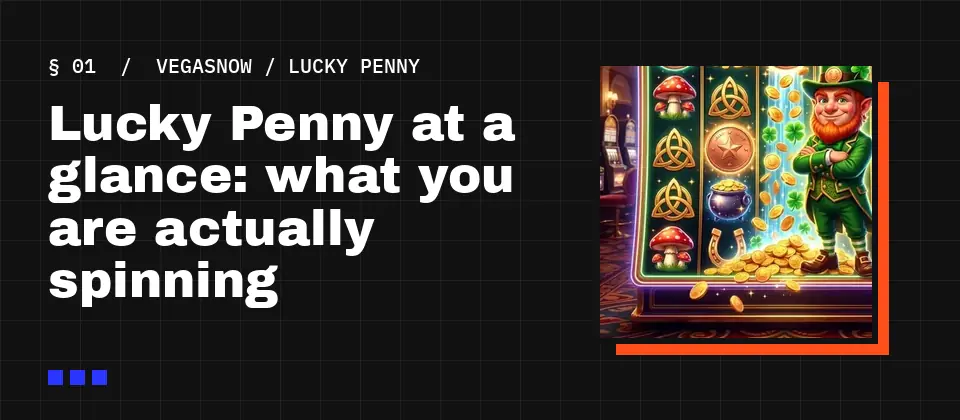
Lucky Penny is a five-reel, three-row pokie from 3 Oaks Gaming, the studio a lot of Australian players still know by its older Booongo name. All 25 paylines are permanently switched on, so the only things you decide are how much each spin costs and how quickly the reels turn. Two features carry most of the excitement: a short free spins round started by Gold Pot scatters, and a Hold and Win respin round started by six or more Penny Bonus coins. The jackpots live inside that respin round too: four fixed prizes named Mini, Minor, Major and Grand.
- Published return to player
- 95.64%, which leaves the house an edge of 4.36%
- Volatility
- High: long quiet patches, with most of the value packed into the two features
- Stake per spin
- From about A$0.10; the top stake is usually listed at about A$1.25, and as high as about A$2.20 at some casinos
- Top prize
- 12,500x your stake
- Free spins
- 8 spins from three or more Gold Pots, roughly once every 120 spins on average
- Hold and Win
- Six or more Penny Bonus coins on one spin, roughly once every 300 spins on average
Two things are worth knowing before you go further. The return figure and the trigger rates are the numbers published for this game in casino and game listings, and the information panel inside the game is where you confirm the version running on your account. And nothing on this page changes the maths of a spin. What it does is translate the game's behaviour into dollars, so you can pick a stake and a budget that sit comfortably with you.
How this page is organised
The page runs as a series of questions in roughly the order players ask them: what the game is, how a spin pays, how the two features unfold (with worked Hold and Win rounds at A$0.30, A$0.80 and A$1.20), what the numbers mean for your balance, and then the practical side of playing at VegasNow, from bonus terms and phones to the lobby, payments and similar games.
Who makes Lucky Penny, and why do some pages call it a crash game?

The studio behind Lucky Penny is 3 Oaks Gaming. Some listings still credit Booongo, and that is not a second company: Booongo is the earlier brand name of the same studio. So whether a tile, a search result or an old screenshot shows one name or the other, it points to the same maker. In our lobby you can filter by provider, which is useful if you want to line up the rest of the studio's coin-and-respin pokies next to this one.
Reels, not a rocket: what Lucky Penny really is
You may find pages online describing Lucky Penny as a crash title, complete with a multiplier that rises until it "crashes", a chart of earlier rounds and a cash-out button you have to hit in time. That description belongs to an entirely different kind of product. Lucky Penny has reels, paylines, a paytable, a wild, a scatter and a coin-collecting respin feature. There is no climbing multiplier, no chart and no timing decision.
When a page gets something as basic as the game type wrong, it is fair to doubt the rest of its numbers. The same style of listing has quoted a 96% return and a stake range in pounds, neither of which lines up with how the game is described everywhere else. The safest habit is simple: trust the help screen inside the game you open, and use outside descriptions only as a rough map.
Why the difference matters
Crash games and pokies ask different things of you, and they spend your money in different ways.
| Question | Lucky Penny | Typical crash game |
|---|---|---|
| What decides the result? | Where the reels stop, set by the random number generator | When you cash out compared with when the round ends |
| Any decisions once the round starts? | None after you press spin | Yes, the cash-out moment |
| Bonus features | Free spins, Hold and Win, four fixed jackpots | Usually no reel-style features |
| Where to find it at VegasNow | The Slots (pokies) category | The crash and instant games area |
Because nothing you do mid-spin changes the outcome, a plan for Lucky Penny is a budget plan rather than a tactics plan. You choose a stake, a balance and a stopping point; the reels do the rest.
Where it sits in the studio's catalogue
3 Oaks builds a lot of Hold and Win pokies, and the published returns for its catalogue sit in a tight band. Listings put 3 Aztec Temples at 95.7%, 3 Clover Pots Extra and Coin Lamp at 95.63%, and 3 African Drums at 95.68%. Lucky Penny's 95.64% lands squarely in that cluster, so it looks like the studio's usual setting rather than an unusually stingy one. Where it does stand apart is the ceiling. Its 12,500x top prize is well above the 1,000x to 5,000x listed for those siblings, and that higher ceiling is one of the reasons the game is described as high volatility.
Six things people get wrong about Lucky Penny
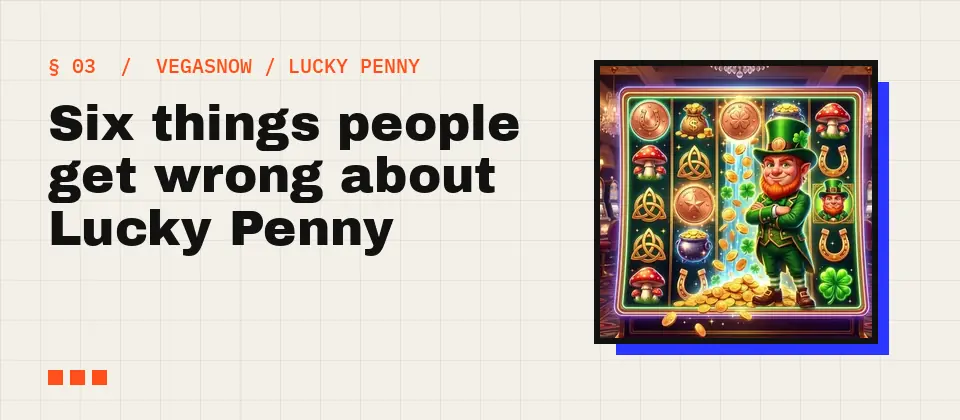
These beliefs about Lucky Penny, and penny pokies in general, come up often. Here they are with the numbers that settle them.
1. "Penny means the evening costs pennies"
The name describes the lowest stake, not the cost of an evening. What you spend per hour depends on three things: the stake, how many spins you take and the house edge. At A$0.20 a spin and a steady 12 spins a minute, you put A$144 through the game in an hour. The house edge of 4.36% takes an average of about A$6.28 out of that hour. Push the stake to A$0.80 at the same pace and the hour's turnover becomes A$576, with an average cost near A$25.11. Same game, same name, four times the cost.
2. "The game runs hot and cold"
The random number generator settles each spin with no memory of the one before. If 250 spins pass without a feature, spin 251 has exactly the same chance of starting one as the first spin of the day. A long gap is not a sign that something is "due", and a feature does not mean the game has "cooled off".
3. "Higher stakes improve the odds"
The edge is the same 4.36% whether you play at A$0.10 or at the top of the range. At A$0.10 a spin, 100 spins cost about A$0.44 on average; at A$2.20, about A$9.59. Raising the stake scales the wins and the losses together. It does not tilt anything in your favour.
4. "The free-play version shows how the real game will treat me"
A demo uses the same reels and rules, but it is not a forecast. Australian research on simulated gambling has found that practice versions on some real-money sites pay out more generously and trigger features more readily than their paid counterparts. Use a demo to learn the screen, not to predict results.
5. "Hold and Win always pays a jackpot, so it cannot lose"
It is true that no Hold and Win round can finish below the Mini tier, because six coins start the round and six coins is the Mini threshold. But you pay for the round before it arrives: around 300 spins on average. At A$0.50 a spin, that is roughly A$150 of stakes for each trigger, and a Mini prize plus a handful of coins will not always cover it.
6. "The jackpots grow while people play"
All four Lucky Penny jackpots are fixed. Nothing is added to them from other players' spins, so there is no point waiting for a jackpot to "build up" before you play.
How does one spin of Lucky Penny play out?

The structure is about as classic as modern pokies get: five reels, three rows, fifteen visible positions and 25 paylines that never switch off. Here is everything that happens between pressing the button and seeing your balance change.
- You set the stake. The stake selector covers the whole spin across all 25 lines. You cannot play fewer lines to spend less; you lower the stake instead.
- The reels stop. The random number generator picks the stopping positions the instant you spin. Animations, sound and spin speed are presentation only.
- Line wins are counted. Matching symbols are counted from reel 1 rightwards along any of the 25 lines, and a run has to continue across neighbouring reels without a gap. Two or more lines can win at once, and the game adds them together.
- Scatters are counted. Gold Pots do not need a line. Three or more of them start the free spins.
- Coins are counted. Penny Bonus coins carry cash values. Six or more on one spin start Hold and Win.
- The total is paid. Line wins go straight to your balance, and any feature that has been triggered starts straight after.
The only three controls that matter
Once the lines are fixed, your choices come down to stake size, spin speed and whether to use autoplay. None of them changes the return. Quick spin simply squeezes more spins into an hour, which raises the hourly cost at any stake. Autoplay removes the pause between spins, which is convenient but also removes the natural moment where you notice your balance. If you use it, set a small number of spins and a loss stop where the game offers one.
Why a "win" is not always a win
Lucky Penny pays small amounts often, and many of those amounts are smaller than the spin that produced them. Suppose you play at A$0.50 and a single line of three Jacks lands. On the line-bet reading of the paytable explained further down, that pays A$0.06. The reels flash and the win counter ticks up, but your balance has dropped by A$0.44 on that spin. Keeping your eye on the balance figure rather than the celebration is the most valuable habit to bring to this game.
Nothing to optimise mid-spin
Some table games reward correct decisions. Pokies do not. No stake pattern, timing trick or button sequence alters the outcome of a spin on Lucky Penny, and any system claiming otherwise is selling something. The decisions that genuinely help are made before the first spin: how much to put in, what stake to use, and when to stop.
Which symbols matter on the Lucky Penny reels?
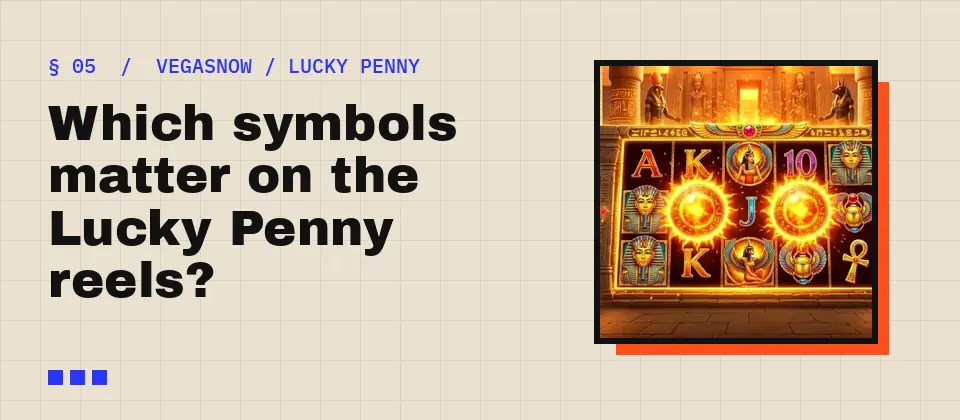
The theme is good fortune and treasure: copper coins, lucky horseshoes, four-leaf clovers, gold-filled pots and card royals dressed in the same style. Seven kinds of symbol do all the work, and three of them behave differently from the rest.
| Symbol | Type | What it does |
|---|---|---|
| Lucky Penny | Wild | Replaces any regular paying symbol (never the Gold Pot or the Penny Bonus coin), pays the biggest line prize itself and can expand to fill a whole reel |
| Lucky Horseshoe | Premium | Highest-paying regular symbol |
| Four-Leaf Clover | Premium | Second-highest regular symbol |
| A and K | Royals | Middle and lower line prizes |
| Q and J | Royals | The smallest line prizes; the two share the same values |
| Gold Pot | Scatter | Published details place it on reels 1, 3 and 5; land three or more for 8 free spins |
| Penny Bonus coin | Bonus | Shows a cash value; six or more on one spin start Hold and Win |
The wild cannot help with either feature
Because the wild does not replace the Gold Pot or the coin, it can never complete a scatter trigger or bring a fifth coin up to six. It only works on line wins. That is worth knowing when you see five coins and a wild on the same screen: the wild is not a sixth coin, and the respin round will not start.
Where the scatters can land
Gold Pots are reported on reels 1, 3 and 5 only. In practice that means the free spins trigger is a matter of one pot on each of those three reels, and, going by those reports, reels 2 and 4 never carry one. If you see two pots on reels 1 and 3, the whole question rests on reel 5.
Coins are a separate prize system
Penny Bonus coins carry their own values that are paid separately from payline wins. In the base game, a few coins scattered around the grid do nothing on their own; they only count when six or more arrive together. During Hold and Win, every coin that locks adds its value to the final total, and the number of coins decides which jackpot tier you reach.
Reading the screen quickly
After a few dozen spins, most players find that their eyes go to three places: any wild that lands, especially one that expands, the pots on reels 1, 3 and 5, and the coin count anywhere on the grid. The royals take care of themselves. Everything that changes a session happens through those three symbol types.
What does the Lucky Penny paytable pay at your stake?
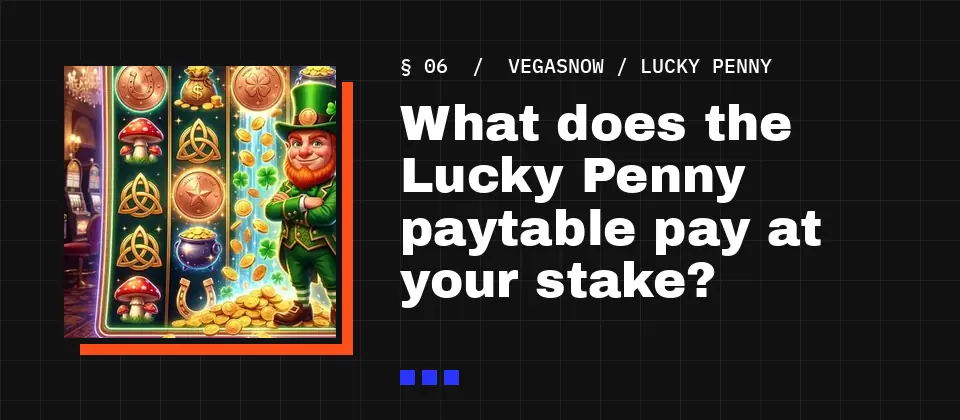
Each regular symbol pays for a run of three, four or five from the left. The values below are the ones published for this game, set out from the smallest symbol up so the jump to the premiums is easy to see.
| Symbol (lowest first) | Run of 3 | Run of 4 | Run of 5 |
|---|---|---|---|
| J or Q (same values) | 3x | 12x | 50x |
| K | 4x | 15x | 60x |
| A | 5x | 20x | 75x |
| Clover | 10x | 40x | 150x |
| Horseshoe | 12x | 50x | 200x |
| Wild penny | 25x | 100x | 500x |
Multiplier of what?
Listings do not always say what these numbers multiply. On a fixed 25-line pokie, the usual reading is the line bet: your total stake divided by 25. That reading fits how the game is described, with small, frequent line wins that are often below the cost of the spin. If the values were multiples of the whole stake, every three-Jack hit would be a profit, which does not square with a high-volatility game returning 95.64%. Even so, the paytable inside the game is the final word, so open it once at your chosen stake before you play for real.
The same table in dollars at A$0.75 a spin
At a A$0.75 stake, the line bet is A$0.03. Multiply each value by three cents and the table becomes:
| Symbol | Run of 5 | Run of 4 | Run of 3 |
|---|---|---|---|
| Wild (the penny itself) | A$15.00 | A$3.00 | A$0.75 |
| Lucky Horseshoe | A$6.00 | A$1.50 | A$0.36 |
| Four-Leaf Clover | A$4.50 | A$1.20 | A$0.30 |
| Ace | A$2.25 | A$0.60 | A$0.15 |
| King | A$1.80 | A$0.45 | A$0.12 |
| Queen or Jack | A$1.50 | A$0.36 | A$0.09 |
Three of a kind across three stakes
The three-symbol prizes are the ones you will see most, so they are the ones that shape how a session feels.
| Three of | A$0.25 stake (A$0.01 line) | A$0.75 stake (A$0.03 line) | A$1.25 stake (A$0.05 line) |
|---|---|---|---|
| Queen or Jack | A$0.03 | A$0.09 | A$0.15 |
| King | A$0.04 | A$0.12 | A$0.20 |
| Ace | A$0.05 | A$0.15 | A$0.25 |
| Four-Leaf Clover | A$0.10 | A$0.30 | A$0.50 |
| Lucky Horseshoe | A$0.12 | A$0.36 | A$0.60 |
The pattern is the same at every stake: a single three-of-a-kind returns between 12% and 48% of the spin cost. Only when several lines pay together, or when four and five of a kind land, does a base-game spin move into profit.
A five-minute exercise before you play
Pick the stake you intend to use, divide it by 25, and write down what a three-Queen line and a five-wild line are worth in dollars. The first number tells you what most of your wins will look like. The second tells you the biggest single line prize the base game can produce: 500 line bets, which works out at 20 times your total stake. Everything above that comes from the features, which is why the next few sections focus on them.
How do the wilds and expanding reels change a spin?
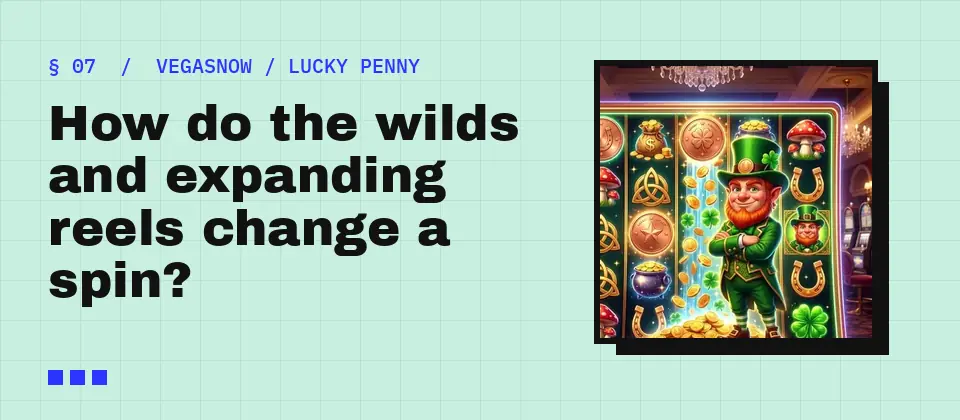
The Lucky Penny wild does two jobs. On a normal landing it acts as any paying symbol it needs to be, so a Horseshoe, a wild and another Horseshoe on a line count as three Horseshoes. Now and then it also expands, stretching up or down to cover all three positions on its reel. That second behaviour is what turns an ordinary spin into a multi-line hit.
Why a full wild reel is so useful
Each of the 25 paylines crosses every reel once. When a wild fills a reel from top to bottom, every one of those lines passes through a wild at that point. If the wild reel is reel 2, any line that has the same symbol on reel 1 and reel 3 now pays at least a three-of-a-kind, and lines with a match on reel 4 as well pay four of a kind.
A worked example at A$0.50 a spin
At a A$0.50 stake the line bet is A$0.02. Imagine reel 2 is fully wild, and once you trace the line map, three lines run Ace to wild to Ace across the first three reels and two lines run Clover to wild to Clover. The line counts here are made up to show the sum; the game's own line map decides the real ones.
- Three Aces pay 5 line bets: 5 x A$0.02 = A$0.10 per line, so three lines pay A$0.30.
- Three Clovers pay 10 line bets: 10 x A$0.02 = A$0.20 per line, so two lines pay A$0.40.
- Total for the spin: A$0.70 from a A$0.50 stake, a profit of A$0.20.
Now suppose one of those Clover lines also had a Clover on reel 4. It moves from three of a kind (10 line bets) to four (40 line bets), and that single line is worth A$0.80 instead of A$0.20. The spin total becomes A$1.30. That is the shape of a good base-game spin on Lucky Penny: not one big line, but several lines stacking up because of one expanded reel.
The wild's own prize, in context
Five wilds on one line pay 500 line bets, the largest line prize in the game. Because a line bet is one twenty-fifth of your stake, that top line hit equals 20 times the stake: A$10 at A$0.50, A$25 at A$1.25. Pleasant, but small next to the game's 12,500x ceiling. The maths makes the point plainly: the big numbers in Lucky Penny come from the features, while the wild mostly keeps the base game ticking over between them.
Wilds during free spins
Published descriptions say expanding wilds show up more frequently once the free spins start. That is why the round, short as it is, can occasionally produce a stand-out result: two or three expanded reels in the same spin connect a large share of the 25 lines at once.
How do you trigger the free spins, and what happens in the round?
Of Lucky Penny's two features, the free spins round has the shorter rulebook and comes round far more often. Here it is in four lines.
- Land three or more Gold Pot scatters in the same spin. They are reported to appear only on reels 1, 3 and 5, and they do not need to sit on a payline.
- Collect 8 free spins. The round costs nothing extra from your balance.
- Watch for more pots. Further scatters landing inside the round retrigger it and extend the number of spins.
- Expect extra wild action. Published details say expanding wilds are more frequent here than in the base game.
How often, in plain numbers
The published trigger rate is about one round per 120 spins. Think of it as what happens across thousands of spins, not as a schedule. If each spin carries the same rough one-in-120 chance, then:
- within 60 spins, about 40 players in 100 will have seen the round at least once;
- within 120 spins, about 63 in 100;
- within 240 spins, about 87 in 100;
- and around 5 players in 100 will still be waiting after 360 spins.
That last line is the one to plan for. A 360-spin wait is not rare bad luck; it is a normal outcome for a small but steady share of sessions.
What the wait costs at your stake
An average gap of 120 spins means the round is "paid for" by the spins that come before it. A$0.40 stakes over those 120 spins add up to A$48 per round on average. At A$0.90, it is A$108. Base-game wins hand some of that back along the way, but it helps to think of every free spins round as something you have funded in advance.
Eight spins is a short round
By current standards, eight free spins is brief. Most rounds return a modest amount; occasionally the extra wilds line up and the result is genuinely large. It behaves like a variance amplifier rather than a dependable top-up, so do not plan a budget around any particular free spins result.
Game free spins and promotional free spins are different things
The eight spins inside Lucky Penny are part of the game. Winnings from them go to whatever balance you were playing with. Free spins you receive from a VegasNow promotion are an account award with their own conditions: welcome-spin winnings need 40x wagering and stop at A$300, and the promotion itself names the games they work on. If you are unsure which kind you are looking at, check the bonus section of your account; our bonus overview lists every condition.
How does Hold and Win work, one respin at a time?
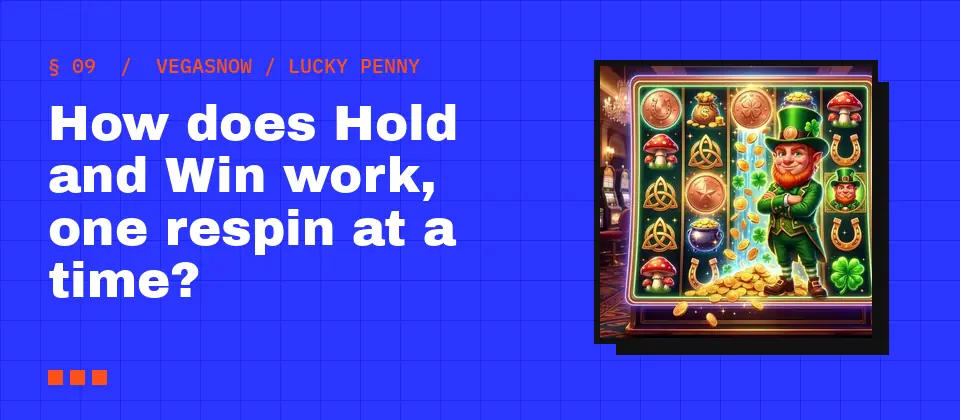
Everything big in Lucky Penny runs through Hold and Win, including all four jackpots, so the exact rules are worth a minute of your time.
- Start: a single spin shows six or more Penny Bonus coins.
- Lock: the coins that triggered the round stay fixed in their positions, and the rest of the fifteen-position grid is left open for new coins.
- Respins: you receive three respins.
- Reset: a respin that brings in at least one fresh coin locks it alongside the others and refills the counter to three.
- Finish: play stops once three consecutive respins come up empty, or the moment all fifteen positions are taken.
- Pay: the game totals the values printed on all locked coins, then adds the jackpot for the tier your coin count reached.
The counter is the whole story
What makes the round gripping is the reset. With two respins gone and one left, a single coin buys you three more chances. Several coins in one respin count the same as one for the counter, but each one adds its value and pushes you up the coin ladder. A long round is simply a run of respins where the gap between new coins never reaches three.
How far you have to climb
The number of coins at the trigger sets how far you are from each jackpot threshold. The table counts the coins you still need.
| Coins at trigger | Open positions | To reach Minor (9) | To reach Major (12) | To reach Grand (15) |
|---|---|---|---|---|
| 6 | 9 | 3 more | 6 more | 9 more |
| 7 | 8 | 2 more | 5 more | 8 more |
| 8 | 7 | 1 more | 4 more | 7 more |
| 9 | 6 | already there | 3 more | 6 more |
| 10 | 5 | already there | 2 more | 5 more |
How often it comes round
The published rate is about one Hold and Win round per 300 spins, which makes it roughly two and a half times rarer than free spins. At a A$0.60 stake, the average stake spent between rounds is A$180. At A$0.25 it is A$75. Those figures are the honest price tag on the feature, and they are worth having in mind before you sit down with a small balance.
A design that is easy to follow
Part of the appeal is that you can see everything: locked coins, empty spaces and the counter. Nothing is hidden behind a mystery reveal. That clarity is good design, but it also makes near-misses vivid. Ending one coin short of the next tier feels closer than it is, because each tier still depends on fresh coins landing before the counter runs out. Enjoy the round for what it is and judge it by the total paid, not by how close the next tier looked.
Hold and Win worked examples at A$0.30, A$0.80 and A$1.20
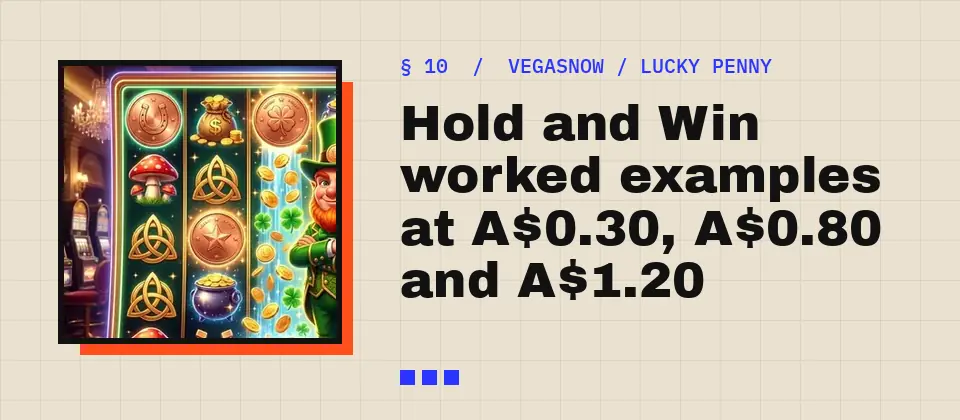
The examples below show how a round adds up at three different stakes. One important note first: the published material for this game does not list the coin values or the four jackpot amounts. The coin values here are invented purely to show the arithmetic. In the game, each coin shows its own value, and the game's help screens set out the prize for each jackpot tier.
Example 1: A$0.30 a spin, a short round
Six coins land and trigger the round, showing A$0.30, A$0.60, A$0.30, A$0.90, A$0.30 and A$1.50. Their total is A$3.90.
- Respin 1: nothing. Two respins left.
- Respin 2: one coin worth A$0.60 lands. Seven coins, A$4.50 in total, counter back to three.
- Respins 3, 4 and 5: nothing, nothing, nothing. The round ends.
Result: seven coins, so the round sits in the Mini band (six to eight coins). You are paid A$4.50 from the coins plus the Mini prize. The coins alone come to 15 times the stake.
Example 2: A$0.80 a spin, one coin short
Eight coins trigger the round: A$0.80, A$1.60, A$0.80, A$4.00, A$2.40, A$0.80, A$1.60 and A$8.00. They add up to A$20.00.
- Respin 1: a A$1.60 coin lands. Nine coins, A$21.60, and the Minor band is reached. Counter resets.
- Respin 1 again: nothing. Respin 2: two coins land, A$0.80 and A$2.40. Eleven coins, A$24.80. Counter resets.
- The next three respins are all blank, which closes the round.
Result: eleven coins, which is the top of the Minor band. You collect A$24.80 plus the Minor prize, with the coins worth 31 times the stake. One more coin would have reached the Major, and that is exactly the kind of finish that feels closer than it was.
Example 3: A$1.20 a spin, a long climb
To keep the sums readable, this example writes each coin as a multiple of the stake. Six coins trigger the round at 1x, 2x, 1x, 3x, 1x and 5x the stake: 13 stakes in total, or A$15.60.
| Step | New coins (x stake) | Coins locked | Running total (x stake) | Running total (A$) | Tier |
|---|---|---|---|---|---|
| Trigger | 1, 2, 1, 3, 1, 5 | 6 | 13 | 15.60 | Mini |
| Respin | 2 | 7 | 15 | 18.00 | Mini |
| Respin | 1 | 8 | 16 | 19.20 | Mini |
| Respin (after one blank) | 1 | 9 | 17 | 20.40 | Minor |
| Respin | 2 and 1 | 11 | 20 | 24.00 | Minor |
| Respin (after one blank) | 10 | 12 | 30 | 36.00 | Major |
| Respin | 1 | 13 | 31 | 37.20 | Major |
| Three blanks | none | 13 | 31 | 37.20 | Round ends |
Result: thirteen coins, inside the Major band (twelve to fourteen). You receive A$37.20 from the coins plus the Major prize. Two positions stayed empty, and the Grand needs every one of the fifteen filled.
Putting the three rounds side by side
| Stake | Coins at trigger | Coins at finish | Coin total | Coins as x stake | Tier reached |
|---|---|---|---|---|---|
| A$0.30 | 6 | 7 | A$4.50 | 15x | Mini |
| A$0.80 | 8 | 11 | A$24.80 | 31x | Minor |
| A$1.20 | 6 | 13 | A$37.20 | 31x | Major |
Set those totals against the price of getting there. With one round per 300 spins on average, the typical stake spent before each round is A$90 at A$0.30, A$240 at A$0.80 and A$360 at A$1.20. The tier prize on top is what can turn a round into a real result, which is why the four jackpot amounts in the game's help screens are worth checking before you start.
How are the Mini, Minor, Major and Grand jackpots decided?
Lucky Penny's four jackpots are tied directly to the number of coins you finish the Hold and Win round with. There is no separate jackpot wheel or random jackpot spin. Count the coins and you know your tier.
| Tier | Coins at the end of the round | Extra coins needed after a six-coin trigger |
|---|---|---|
| Mini | 6 to 8 | None |
| Minor | 9 to 11 | 3 |
| Major | 12 to 14 | 6 |
| Grand | All 15 positions | 9 |
Fixed, not progressive
The four prizes are fixed. They do not grow from a share of other players' stakes, and they do not reset after someone wins. That makes the game easy to plan around: there is no "big pool" moment to wait for, and the prize you see listed is the prize the game pays for that tier.
Why the Mini always lands
Six coins start the round, and six coins is also the bottom of the Mini band. So every Hold and Win round finishes with at least the Mini. That guarantee is real, but it is built into the price of the feature. You will have spent around 300 spins on average to reach the round, and a Mini prize plus a few coins is often a modest return on that outlay.
The long road to the Grand
From a six-coin start, the Grand needs nine more coins, each landing before three empty respins in a row end the round. No probability for the Grand has been published for this game, and we won't make one up. The structure alone says it sits at the top of a long ladder, and most rounds stop well short of it. Treat it as a possibility, not a target.
Jackpots and bonus funds
With a deposit bonus running, our default terms stop deposit-bonus winnings at A$5,000 unless a particular offer names another figure. A large jackpot landed while a bonus is running may therefore be limited by that cap. Players who are chasing a big feature result often prefer to play with their own cash balance for that reason, and turning down a bonus at deposit time is always allowed.
Checking the prizes before you play
The published listings for Lucky Penny give the tier rules but not the prize amounts. Open the help screens in the game and note the four amounts at your stake before your first real spin. Then compare them with the stake spent, on average, to reach the round. That comparison tells you more about whether a stake suits you than any headline figure.
How often do the features turn up? Odds by session length

Average trigger rates are easy to quote and easy to misread. "One in 120" does not mean the round arrives every 120 spins. A clearer way to see it is to ask: after a given number of spins, how many players out of 100 will have seen each feature at least once? The table assumes every spin has the same chance as the published averages, about one in 120 for free spins and one in 300 for Hold and Win, and rounds to whole numbers.
| Spins played | Free spins at least once | Hold and Win at least once | Neither feature yet |
|---|---|---|---|
| 50 | 34 | 15 | 56 |
| 100 | 57 | 28 | 31 |
| 240 | 87 | 55 | 6 |
| 300 | 92 | 63 | 3 |
| 600 | 99 | 87 | under 1 |
| 900 | almost all | 95 | under 1 |
Three things the table shows
Hold and Win is not a short-session feature. After 100 spins, only about 28 players in 100 have seen it. Even after 300 spins, the number that has is only about 63. If your balance covers 100 spins, there is a good chance you will not meet the game's main feature at all.
Free spins are the regular visitor. By 240 spins almost nine in ten players have had at least one round. For most sessions, the free spins round and the base game are what you actually play, with Hold and Win as the occasional event.
Dry runs are normal. Around 31 players in 100 reach spin 100 with no feature of either kind. Nobody has done anything wrong in that situation, and the game is not broken; it is how a high-volatility title spreads its returns.
Turning spins into dollars
Spin counts only matter once you attach a stake to them. Here is the stake spent on the same milestones at three stake levels.
| Spins | At A$0.20 | At A$0.45 | At A$1.10 |
|---|---|---|---|
| 100 | A$20 | A$45 | A$110 |
| 240 | A$48 | A$108 | A$264 |
| 300 | A$60 | A$135 | A$330 |
| 600 | A$120 | A$270 | A$660 |
These are amounts staked, not lost, since wins hand part of it back along the way. They show why stake size is the real decision: 600 spins' worth of play, enough for a strong chance at Hold and Win, needs a very different balance at A$1.10 than at A$0.20.
What does a 95.64% RTP mean for your balance?
RTP stands for return to player. Average Lucky Penny's results over an enormous run of spins and 95.64% of everything wagered comes back as wins; that is the published figure. Take that away from 100% and you get the house edge: 4.36%. In everyday terms, the game keeps an average of 4.36 cents from every dollar that passes through it, and hands the rest back as wins.
The same figure at amounts you might actually stake
| Total staked | Average paid back | Average cost |
|---|---|---|
| A$40 | A$38.26 | A$1.74 |
| A$250 | A$239.10 | A$10.90 |
| A$750 | A$717.30 | A$32.70 |
| A$2,000 | A$1,912.80 | A$87.20 |
Notice the column header: total staked, not total deposited. If you deposit A$50 and spin it round several times, your total staked can easily reach A$250 or more, and the average cost is worked out on that larger number.
Five hundred spins at four different stakes
| Stake | Total staked over 500 spins | Average cost at 4.36% |
|---|---|---|
| A$0.20 | A$100 | A$4.36 |
| A$0.45 | A$225 | A$9.81 |
| A$0.90 | A$450 | A$19.62 |
| A$1.25 | A$625 | A$27.25 |
What RTP does not tell you
The figure is an average over millions of spins. It says nothing reliable about one evening. On a high-volatility game, a 500-spin session can easily end far below the average cost in the table, and occasionally far above break-even. The average describes the middle of a very wide spread, and on Lucky Penny the spread is the part you will notice.
A note on the 96% figure you may see elsewhere
One outside listing quotes 96% for Lucky Penny. That same listing describes the game as a crash title, so it appears to be describing something else entirely. The figure published consistently for this game is 95.64%. Whatever you read online, the game's information panel in our lobby shows the return for the version you are actually playing, and that is the number to go by.
How much difference does a point or so of RTP make?
Compare Lucky Penny with a hypothetical pokie paying back 97%, an edge of 3%. Over A$750 of stakes, Lucky Penny's average cost is A$32.70 and the 97% game's is A$22.50. The gap of A$10.20 sounds small, but it means the same money buys roughly 45% more average playing time on the higher-return game. If long sessions matter to you more than a high ceiling, that is a fair trade to consider. If the four-tier jackpot and the 12,500x ceiling are what you are here for, the slightly higher edge is the price of that structure.
How long might a deposit last on Lucky Penny?

There are two ways to answer this, and you need both. The first is the average: how much a given stake costs per hour once the house edge has done its work. The second is the swing: how far your balance can move away from that average in a high-volatility game. Players who only look at the first number are usually surprised by the second.
The average, per hour
Spin pace varies a lot from player to player. The table uses a relaxed 10 spins a minute, which comes to 600 spins an hour. If you use quick spin or autoplay, your pace can be noticeably higher, and every figure in the table rises in proportion.
| Stake | Turnover in an hour | Typical hourly cost (average) |
|---|---|---|
| A$0.20 | A$120 | A$5.23 |
| A$0.50 | A$300 | A$13.08 |
| A$0.90 | A$540 | A$23.54 |
| A$1.25 | A$750 | A$32.70 |
On those averages, a A$60 deposit at A$0.20 would cover more than eleven hours of play. That figure is technically right and practically misleading, which brings us to the swing.
The swing, in stakes
A more useful way to measure a balance is in stakes: divide your balance by your spin cost. A$60 at A$0.20 is 300 stakes. A$60 at A$0.50 is 120 stakes. A$60 at A$1.25 is 48 stakes.
Now remember the published gaps for this game: a free spins round near every 120th spin on average, a Hold and Win round near every 300th, and reported stretches of 200 to 400 spins between substantial wins. A balance of 48 stakes can disappear before either feature appears. A balance of 120 stakes gives you about a 63 in 100 chance of seeing free spins before it runs out, if base-game wins do not stretch it further. A balance of 300 stakes gives the game room to show you what it is built around.
A worked comparison
Two players each deposit A$90. One plays at A$0.30 (300 stakes), the other at A$1.10 (about 82 stakes). The average hourly cost is A$7.85 for the first and A$28.78 for the second at 600 spins an hour. More importantly, the first player has a realistic chance of seeing a Hold and Win round before the balance runs low; the second will be relying on base-game wins and an early free spins round to stay in the game long enough to meet it.
What usually ends a session
In practice, Lucky Penny sessions rarely end by slowly grinding down to the average. They end in one of two ways: a dry spell that eats the balance before a feature lands, or a feature that lifts the balance and gives you a decision about whether to keep going. Planning for both, with a loss limit for the first and a "bank some of it" rule for the second, matters more than any hourly figure.
How volatile is Lucky Penny, in plain numbers?
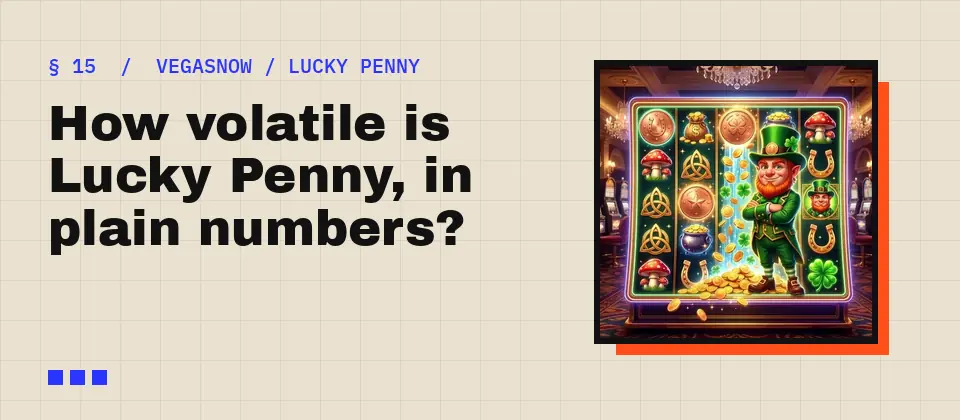
Lucky Penny is listed as a high-volatility pokie. One brief listing calls it medium, but that label does not fit the rest of the published profile: a four-tier jackpot ladder, a 12,500x ceiling and long gaps between substantial wins. We go with high, and the figures below show what that means for you.
The published rhythm of the game
- Small wins
- About one every 8 to 12 spins, often worth less than the stake
- Free spins
- About one round per 120 spins
- Hold and Win
- About one round per 300 spins
- Substantial wins
- Published gaps of 200 to 400 spins separate them
- Where the value sits
- Around 75% of total returns are reported to come from the features
What "75% from features" means in dollars
Take A$1,000 of stakes. At 95.64%, the average amount paid back is A$956.40. If roughly three-quarters of that comes from free spins and Hold and Win, about A$717 arrives through the features and only about A$239 through ordinary line wins in the base game. In other words, while you are waiting for a feature, the reels on their own are handing back something like a quarter of what you stake. That is the clearest picture of high volatility you will find: the base game mainly carries you from one feature to the next.
What a long gap costs at your stake
| Stake | 200 spins | 400 spins |
|---|---|---|
| A$0.15 | A$30 | A$60 |
| A$0.35 | A$70 | A$140 |
| A$0.70 | A$140 | A$280 |
| A$1.25 | A$250 | A$500 |
Again, these are stakes rather than losses; small wins come back along the way. But if a gap of that size would empty your balance at the stake you have chosen, the stake is too high for the balance.
High volatility is not "bad", it is a shape
Low-volatility pokies return money in small, steady amounts and rarely produce a large result. High-volatility pokies like Lucky Penny hold back more of the return for less frequent, larger events. Neither is better in principle. The question is which shape suits your budget and your patience. If an hour of mostly small, below-stake wins sounds tedious, a gentler game will feel better. If you are happy to trade steady play for the chance of a big Hold and Win round, Lucky Penny is built for exactly that.
How it should change your plan
High volatility asks for three adjustments: a bigger balance measured in stakes, a firm loss limit set before you start, and a plan for an early feature win. Those three decisions are covered in the bankroll section further down.
Your first 100 spins: what the numbers say to expect
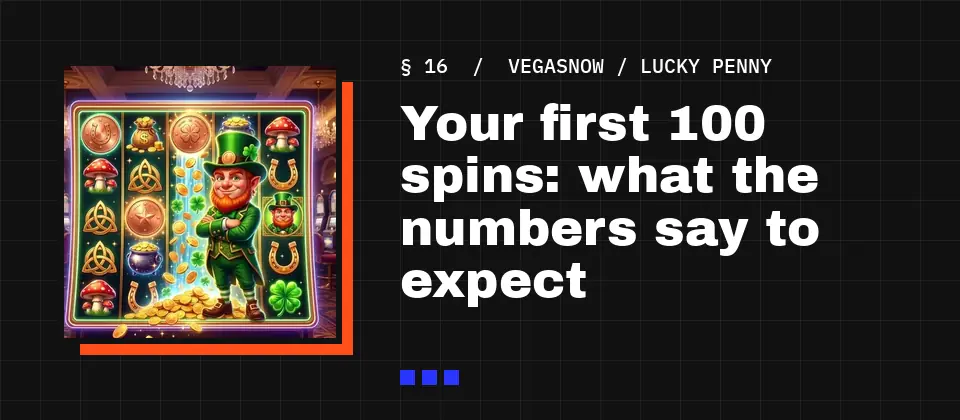
Here is a practical walk through a first session, built entirely from the published figures and our own arithmetic. It is not a record of anyone's play. It is a way of knowing in advance what "normal" looks like, so you are not surprised by it. The stake throughout is A$0.50, which makes the line bet A$0.02 and puts A$50 through the game over 100 spins.
Before spin 1
- Open the paytable and the information panel. Check the return figure shown and that the title is the original Lucky Penny.
- Note what three Queens pay at A$0.50 (A$0.06 on the line-bet reading) and what five wilds pay (A$10).
- Write down your starting balance and your loss limit for the session.
Spins 1 to 25 (A$12.50 staked)
With small wins reported every 8 to 12 spins, expect two or three of them, most smaller than the A$0.50 stake. About 19 players in 100 will see free spins in this stretch and about 8 in 100 will see Hold and Win. For most people, this is a quiet start and the balance edges down.
Spins 26 to 50 (A$25 staked in total)
By spin 50, about 34 in 100 players have had a free spins round and about 15 in 100 have reached Hold and Win. More than half have seen neither. If you are in that majority, nothing is wrong. This is a good point to glance at your balance against your starting figure rather than at the win counter.
Spins 51 to 75 (A$37.50 staked in total)
Free spins have now appeared for roughly 47 in 100 players and Hold and Win for about 22 in 100. Somewhere around here, an expanded wild or a four-of-a-kind on a premium symbol may give the balance a lift. The base game's best single line, five wilds, would be A$10 at this stake.
Spins 76 to 100 (A$50 staked in total)
By spin 100, about 57 in 100 players have had free spins, about 28 in 100 have had Hold and Win, and about 31 in 100 have had neither. The average cost of the 100 spins is A$2.18 (A$50 at 4.36%), but actual outcomes spread widely around that: some balances are down A$20 or more, a few are up after a good feature.
| By spin | Staked | Free spins seen | Hold and Win seen |
|---|---|---|---|
| 25 | A$12.50 | 19 | 8 |
| 50 | A$25.00 | 34 | 15 |
| 75 | A$37.50 | 47 | 22 |
| 100 | A$50.00 | 57 | 28 |
The decision at spin 100
Stop and compare your balance with where you started. If you are above your loss limit and still enjoying it, carry on with the same stake. If a feature paid well, consider moving part of the win out of play. If you are close to your limit, the next 100 spins carry exactly the same odds as the first 100: nothing is "due". Ending the session there is a perfectly good result.
What could you realistically win on Lucky Penny?

Lucky Penny's ceiling, as published, sits at 12,500 times the stake. It is a genuine figure for the game's maximum, and it is also the least useful number on this page for planning a session. Here is what it looks like at different stakes, followed by the more everyday picture.
| Your stake | Top prize |
|---|---|
| A$0.10 | A$1,250 |
| A$0.40 | A$5,000 |
| A$0.80 | A$10,000 |
| A$1.25 | A$15,625 |
| A$2.20 (where offered) | Just under A$28,000 |
How likely is the maximum?
No probability for the top prize has been published for Lucky Penny, and we will not make one up. What can be said with confidence is that a maximum win on a high-volatility pokie is an extreme event at the very edge of the game's range. No sensible budget should depend on it, and no stake level makes it likely.
The more everyday picture
Most of what you see will fall into four bands:
- Small line wins every 8 to 12 spins or so, usually 12% to 48% of the stake for a single three-of-a-kind.
- Better base-game spins where an expanded wild connects several lines, or four or five premium symbols land. The best single line, five wilds, is 20 times the stake.
- Free spins rounds roughly once per 120 spins: mostly modest, occasionally large when wilds expand on several reels.
- Hold and Win rounds roughly once per 300 spins: the coin total plus at least the Mini prize, with the Minor, Major and Grand reached on progressively longer runs of coins.
The honest expectation
Put A$600 through the game at any stake and the average result is A$573.84 paid back and A$26.16 kept by the house. Individual sessions spread widely either side. Some end at zero, a few end well ahead, and the middle of the spread is a small loss. That is what every commercial pokie looks like on paper, and it is the right frame for Lucky Penny: entertainment with a known average price, and a slim chance of something much larger.
If a big win does land
Two practical points apply at VegasNow. First, our daily (A$6,000), weekly (A$12,000) and monthly (A$42,000) withdrawal ceilings, all counted in UTC, mean a large win can arrive in instalments rather than one transfer; our withdrawal page explains the stages. Second, if a deposit bonus was running at the time, its winnings are limited to A$5,000 by default. Knowing both before you play avoids an unpleasant surprise at the cashier.
Is there a Lucky Penny bonus buy in our lobby?

A bonus buy (some games call it a feature buy) charges a fixed price to skip the wait and drop you straight into a feature. Some casinos offer one on Lucky Penny and others do not. The option can be switched on or off by the casino, and some countries do not allow it at all. So the straight answer is: it depends on how the game is set up for your account and region.
How to tell
Open the game and look at its main screen. If a buy option is offered to you, it appears inside the game itself, and the help screens describe it. If there is no such option, your account simply does not have it, and the game relies on natural triggers alone. Either way, its presence or absence tells you nothing about the quality of the game or the casino.
What we can and cannot tell you about the price
No verified purchase price has been published for Lucky Penny, so we will not quote one. If a buy is offered to you, the price will be shown in the game before you confirm. Two more checks are worth making: whether the help screens list a separate return figure for bought features, since it is not always the same as the base game's 95.64%, and which feature the purchase actually starts.
Price it in spins
The simplest way to judge a feature purchase is to divide its price by your normal stake. The answer is the number of ordinary spins you are giving up. For example, if a game showed a price of 100 times the stake and you normally play A$0.30, the purchase costs A$30, the same as 100 spins. You can then set that against the table of feature odds earlier on this page: 100 ordinary spins give about a 57 in 100 chance of free spins and 28 in 100 of Hold and Win, plus all the small wins along the way.
Bonus buys and bonus funds do not mix
Whenever bonus money is live on your account, the maximum bet is A$8. A purchase is a single charge, so any buy priced above A$8 would sit above that limit. At a A$0.30 stake, a purchase priced at 100 times the stake is already A$30. Our advice is simple: do not use a bonus buy while a bonus is running, read the exceptions in our bonus terms, and put any doubt about how a purchase would count to our support team first.
Why highlights make buys look better than they are
Clips and streams favour bought features because they deliver drama quickly, which makes them a poor sample of normal results. A purchase speeds up your exposure to the game's biggest swings in both directions, so treat any buy as a ticket you are ready to lose in full.
Can you try the Lucky Penny demo first?

A demo, or free-play mode, swaps your money for play credits: winnings stay on the screen and losses cost nothing. Whether free play is offered for Lucky Penny in our lobby depends on how the game is set up for your region and account. If a free-play option is available, you will see it when you open the game; if not, the game opens in real-money mode only. The thumbnails on our public pages are only a picture gallery, not playable demos.
What a demo is good for
A short demo session is a sensible way to learn the screen without spending anything. In particular, you can:
- find the paytable and information panel, and check the return figure shown;
- see the stake selector's full range for your set-up;
- watch how coins lock and how the respin counter resets in Hold and Win;
- check whether a buy button appears, and what it would cost at your stake.
A five-step demo routine
- Read before you spin. Open the help screens and compare the symbol values with the paytable on this page.
- Use your real stake. Set the demo to the stake you would actually play, not the maximum.
- Run 100 spins and count. Count every spin that paid back less than its own cost, and note the spin numbers where a feature began.
- Track the balance, not the animations. The demo balance means nothing, which makes it a good place to build the habit of watching it.
- Stop there. One or two short runs teach you everything the demo can. Longer sessions add nothing useful.
Three limits of free play
It is not a forecast. A demo run of a few hundred spins is far too short to say anything about a high-volatility game's real behaviour. Australian researchers looking at simulated gambling have also found that practice versions on some real-money sites pay out more freely and reach their features sooner than the versions played for money. Expect real-money play to feel slower than a lucky demo run.
It does not feel the same. Losing virtual credits carries no sting, so decisions you make in a demo, such as raising the stake after a dry patch, do not tell you how you will behave with your own money.
It is not a substitute for a limit. The same research found that simulated play was linked with heavier real-money gambling afterwards, rather than replacing it. Use the demo briefly to learn the game, then close it. It is not a way of "getting it out of your system".
Free credits versus your own money: the differences that matter

The reels, symbols and rules are the same in both modes. Almost everything around them is different, and it helps to see the differences side by side before you make the switch.
| Area | Free play (where offered) | Real money |
|---|---|---|
| Balance | Virtual credits, usually topped up on request | Your deposited funds, plus any bonus you chose to accept |
| Wins | Cannot be withdrawn | Go to your balance and can be withdrawn within account rules |
| Account needed | Depends on set-up | Yes, registered, 18+ and verified before withdrawals |
| Loyalty points | None | One point per A$25 of pokie stakes |
| Bonus wagering | Not applicable | Pokie stakes count 100% unless the game is on the exceptions list |
| Deposit limits and cooling-off | Not applicable | Available on your account |
| Feature frequency | Should match, but cannot be assumed to | Set by the game version on your account |
Making the switch in five steps
- Create your account or sign in. Use one account only; duplicates cause problems with bonuses and withdrawals. Help with signing in and resetting a password is on our login page.
- Get verified early. We commonly ask for ID when you first withdraw, so supplying it early avoids a wait at the moment you want your money.
- Set a deposit limit. Do it before your first deposit, while you are thinking clearly.
- Decide on the bonus. Accept a welcome stage if its terms suit how you play Lucky Penny, or decline it and play with cash only. Both are fine choices.
- Open the game and check the panel. Confirm the title, the return figure and the stake range, then set the stake you planned in demo.
What changes in you
The biggest difference is not on the screen. With real money, a dry spell feels heavier and a near-miss in Hold and Win feels sharper. Those feelings push many players toward raising the stake to "win it back". If you notice that pull, it is the signal to stop for the day, not to adjust the stake. A loss limit written down before you start makes that call much easier.
Real-money loyalty value, in proportion
Each A$25 you stake on pokies adds a loyalty point. Five hundred spins at A$0.50 put A$250 through the game and add 10 points. Swap 200 points in the loyalty store and you receive A$5 in bonus funds, subject to 40x wagering like any bonus. Points are a pleasant extra over months of play, not a reason to raise your stake.
How does Lucky Penny fit our welcome bonus terms?

Four deposits, four stages: together they can add up to A$8,000 of bonus money plus 500 free spins. Every stage accepts deposits from A$20, though card and MiFinity payments carry their own A$30 floor. The table reads each stage from a practical angle: how much you would need to deposit to reach its full amount.
| Stage | Deposit for the full bonus | Bonus at that deposit | Free spins | Code to enter |
|---|---|---|---|---|
| First | A$1,000 | A$1,500 (150% match) | 200 | Not required |
| Second | A$2,000 | A$2,000 (100% match) | 50 | VEGAS2 |
| Third | A$4,000 | A$2,000 (50% match) | 50 | VEGAS3 |
| Fourth | A$10,000 | A$2,500 (25% match) | 200 | VEGAS4 |
Smaller deposits simply earn the same percentage on a smaller amount. The codes and every stage condition are listed on our promo code page.
Where Lucky Penny sits inside the rules
- Contribution. Under our general terms, every dollar staked on a pokie counts in full, apart from titles named as exceptions. Check that Lucky Penny is not one of them before relying on it to clear a bonus.
- Maximum bet of A$8. This applies while any bonus is active. Lucky Penny's top stake is listed at about A$1.25 to A$2.20, so ordinary spins stay comfortably below it. A feature purchase is a different matter, as the bonus buy section explains.
- Seven days. From the moment a bonus is credited, you have a week to complete wagers worth 40 times its value.
- Winnings cap. Unless an offer names another figure, the most a deposit bonus can turn into is A$5,000, a ceiling worth remembering on a game whose top prize is 12,500x.
- One at a time. A second bonus cannot run alongside the first, and turning a bonus down is always an option.
The package's free spins follow their own rules
Spins from the package unlock after you have played through that stage's deposit once. Stages one and four pay their 200 spins in daily batches of 40 for five days. Whatever the spins win is limited to A$300 and needs 40x wagering, and the promotion decides which games they are credited on, which may or may not include Lucky Penny.
Playing deposits through
Away from bonuses, we ask that each deposit is played through three times before it is withdrawn; otherwise a processing fee can be charged. On a A$60 deposit that means A$180 of stakes, and Lucky Penny spins count towards it.
Clearing bonus wagering on Lucky Penny: worked numbers
Wagering is easiest to judge once it is turned into spins, days and an average cost. Here are two examples at the first and second welcome stages, using stakes that suit Lucky Penny's range.
Example A: a A$40 first deposit
At the first stage, A$40 earns a 150% match: a A$60 bonus. Forty times A$60 is A$2,400 of wagering to complete inside seven days.
| Stake | Spins to finish | Daily share across a week | Hours at 600 spins an hour |
|---|---|---|---|
| A$0.40 | 6,000 | about 857 | 10 |
| A$0.80 | 3,000 | about 429 | 5 |
| A$1.20 | 2,000 | about 286 | about 3.3 |
At Lucky Penny's 4.36% edge, the average cost of A$2,400 of play is A$104.64, which is more than the A$60 bonus itself. Along the way, that much pokie turnover would also earn 96 loyalty points.
Example B: a A$150 second deposit with VEGAS2
Enter VEGAS2 with a A$150 second deposit and the 100% match adds A$150 of bonus money, so the wagering target is A$6,000.
| Stake | Spins to finish | Daily share across a week |
|---|---|---|
| A$0.75 | 8,000 | about 1,143 |
| A$1.25 | 4,800 | about 686 |
The average cost of A$6,000 of turnover at 4.36% is A$261.60.
What those numbers mean
On average, wagering a bonus on Lucky Penny costs more than the bonus is worth. That does not make a bonus pointless. It makes it what it really is: extra playing time, with extra shots at the features along the way. Because the game is high volatility, the outcomes are lopsided. Many attempts run the balance down before the wagering is finished. A smaller number hit a good feature early and finish with a withdrawable amount, within the A$5,000 cap.
When declining makes sense
If you would rather keep the freedom to withdraw at any time, play without a bonus. The same is true if you like to change stakes, or if a seven-day schedule of several hundred spins a day sounds like a chore rather than fun. Declining is always allowed and costs you nothing except the extra balance. Either choice is reasonable; the point is to make it with the numbers in front of you.
How big should your Lucky Penny balance be?
The figure usually suggested for high-volatility pokies of this type is a balance of 100 to 200 times your stake. That is not a way to win. It is a buffer that gives the game a fair chance to reach its features before your money runs out, which is the experience Lucky Penny is built around.
| Stake | 100 stakes | 200 stakes |
|---|---|---|
| A$0.15 | A$15 | A$30 |
| A$0.35 | A$35 | A$70 |
| A$0.60 | A$60 | A$120 |
| A$1.25 | A$125 | A$250 |
| A$2.20 (where offered) | A$220 | A$440 |
Working backwards from your budget
Most people start with an amount rather than a stake, so turn the rule around: divide your budget by 200 for a cautious stake and by 100 for the upper limit.
- A$45 budget: A$0.23 to A$0.45. Pick the nearest step at or below that range on the stake selector.
- A$120 budget: A$0.60 to A$1.20.
- A$300 budget: A$1.50 to A$3.00, which is above the top stake in most listings. Playing at the maximum then gives you more than 200 stakes of cushion.
Remember the earlier table of feature odds: even 200 stakes only gives about a 49 in 100 chance of seeing Hold and Win if nothing else comes back along the way. If meeting that round matters to you, lean towards the cautious end.
Three limits to set before spin 1
- A loss limit in dollars. Write it down. When the balance reaches it, the session is over.
- A banking rule for good features. For example: when a feature lifts your balance by 50 stakes or more, set half of the gain aside and do not play it.
- A time limit. At 600 spins an hour, two hours is 1,200 spins. Time limits catch the sessions that money limits miss.
The one rule that matters most
Never raise your stake to win back a loss. The edge is identical at every stake, so a bigger bet only makes the balance move faster. If the loss limit is close and you feel the urge to "go big" for a Hold and Win round, that is precisely the moment to stop.
Playing Lucky Penny on your phone

Lucky Penny is built to run in a web browser, so the game itself needs no installation. Its published technical needs are modest: Android from version 8.0, iOS from version 11.0, a game client of about 9.4 MB, and connection handling that is reported to cope with weaker mobile signals. On a reasonably recent phone, the reels, the coin grid and the respin counter all fit the small screen without trouble.
How VegasNow works on mobile
There is no VegasNow download in Apple's or Google's stores, and we never hand out APK files. On a phone, VegasNow is our mobile website in Safari or Chrome, with the same lobby, cashier, bonus rules and account settings you get on a computer. An icon on your Home Screen gives you the app feel without any download.
iPhone or iPad
- In Safari, load VegasNow and make sure the address is ours before signing in.
- Use the Share button and pick Add to Home Screen.
- Confirm. The new icon simply opens our mobile site.
Android
- In Chrome, load VegasNow.
- Open the three-dot menu at the top right.
- Pick the Home screen or shortcut option your Chrome version shows, and confirm.
Playing with us never involves changing your phone's security settings to allow unknown installs. If a page asks you to do that for a "VegasNow app", it is not ours, so keep your login details away from it. Our app page has more detail, including signing in from a saved icon.
Phone habits that suit this game
Phones make short, frequent sessions easy: at the bus stop, on the couch, late at night. With a game that pays most of its value through features arriving every few hundred spins, quick bursts tend to feel like all cost and no feature. Two habits help. Decide in advance whether a phone session is a quick look or a planned session with a budget. And remember that limits are stored against your account, which means one you set on a laptop also governs your phone.
If the connection drops
Wi-Fi is the safer choice for longer sessions, so a patchy signal does not cut into a Hold and Win round. Should a round cut out, jot down when it happened and which game it was before contacting support.
Where do you find Lucky Penny in our lobby?

Our lobby holds more than 11,000 games, so the fastest route to Lucky Penny is the search box rather than scrolling. Here is the quickest way in, plus two checks that save confusion later.
- Sign in from any browser, desktop or mobile.
- Open the Slots category, where all pokies sit.
- Type "Lucky Penny" into the search. The search also accepts a studio name, so typing the provider is a useful alternative.
- Check the title on the tile. Our lobby artwork has featured Lucky Penny 2, a numbered sequel with its own rules. Make sure you open the game you mean.
- Open the information panel once the game loads, and confirm the studio, the return figure and the stake range.
- Save it. Adding the game to Saved games keeps it one tap away next time.
Searching by studio
Because the studio has traded under two names, a provider search for either 3 Oaks or Booongo may be the one that brings up its catalogue, depending on how a title is labelled. Browsing the studio's list is also a quick way to line up Lucky Penny's relatives, which we look at further down.
If the game does not appear
Game availability can differ by region and by account. If a search for the exact title brings back nothing, the game is not open on your account at that time, and no setting on your side changes that. Studio siblings and the similar games listed below are good places to look instead.
The sequel question
This whole page is about the first Lucky Penny. A sequel can share the theme and the coin-collecting idea while changing the grid, the features, the jackpots or the published figures. If you open Lucky Penny 2, read its own help screens rather than relying on any number here.
Deposits, withdrawals and ID checks for Lucky Penny players

Lucky Penny is played in Australian dollars from your VegasNow balance, and the cashier is identical on mobile and desktop. The table puts each payment method's published deposit range next to what happens when you want money back.
| Method | Deposit range (A$) | Withdrawing the same way |
|---|---|---|
| Credit card | 30 up to 10,000 | No card payout row; ask which route applies before you need it |
| MiFinity | 30 up to 4,000 | Yes, from A$30 up to A$4,000 |
| Cashtocode | 25 up to 400 | No payout row; ask support which route applies |
| Crypto through CPP (ten coins, among them BTC, ETH, USDT, LTC and DOGE) | Minimum set per coin, such as 5 USDT; no published maximum | Yes, within per-coin limits such as USDT 20 to 4,000 |
Bank-style payouts through Inpay, PayAnyBank or wire run from A$300 up to A$6,000. Wherever possible, money returns by the route it came in. Our withdrawal page walks through each stage of a request.
A big Lucky Penny win and the account ceilings
Three account ceilings stack on top of the method limits: A$6,000 is the most that can leave in one UTC calendar day, A$12,000 in one UTC week and A$42,000 in one UTC month. Picture the 12,500x top prize at a A$1.25 stake: A$15,625. Asked for in full, A$6,000 could go on the first day and A$6,000 on the second. If both days fall in the same UTC week, the weekly ceiling is then reached, and the remaining A$3,625 follows after the new week starts. Instalments like these are a normal part of paying a large amount.
Get verified while nothing is riding on it
We usually ask for ID the first time you cash out. Sending your documents soon after registering means a good Hold and Win result is not left waiting while you hunt for a utility bill. The "free" and "instant" labels in the cashier describe the payment step itself; account checks and verification come first.
Two habits for the cashier
- Deposits are meant to be staked three times over before you withdraw them; skipping that can attract a processing fee.
- Once you have asked for a withdrawal, leave it alone rather than pulling it back into play.
Which other games in our lobby feel like Lucky Penny?

If you enjoy the coin-collecting respin idea, there are plenty of relatives to try. Some come from the same studio and share Lucky Penny's design habits; others use a similar Hold and Win structure from a different studio. Each has its own page with its published return, volatility and top prize, so compare those before you switch.
| Game | Studio | Why it is a natural next step |
|---|---|---|
| Gold Express | 3 Oaks Gaming | Same studio and the same respin-and-jackpot family |
| Coin Volcano | 3 Oaks Gaming | Coins sit at the centre of the game, as they do in Lucky Penny's best moments |
| Sun of Egypt 2 | 3 Oaks Gaming | Egyptian setting, same studio, coin respins at its heart |
| Sun of Egypt 3 | 3 Oaks Gaming (Booongo series) | The next game in that series, built around the same respin idea |
| Tiger Gems | 3 Oaks Gaming | Another studio title with Hold and Win at its core |
| Pink Joker | Playson | A different studio's take on hold-and-collect respins |
| Royal Joker | Playson | A joker-themed Hold and Win pokie, useful as a contrast in style |
Gentler relatives from the same studio
If you like the Lucky Penny structure but find its swings too sharp, the studio's catalogue has calmer options, if they show up in your lobby search. 3 Clover Pots Extra is listed as medium-high volatility with a 5,000x top prize, and 3 African Drums as medium volatility with a 4,280x top prize. Both sit near Lucky Penny's return, so you trade ceiling for smoother play rather than paying a different price.
What to compare when you switch
- Return figure: read it in each game's information panel. A difference of a point or so changes how long a balance lasts, as shown earlier.
- Volatility: lower volatility means more frequent, smaller returns and fewer long dry spells.
- Where the jackpot ladder starts: a game whose lowest tier needs fewer coins will feel rewarding more often.
- Top prize: Lucky Penny's 12,500x is high for its type, so most relatives will have a lower ceiling.
- Bonus buy: check whether the option appears on your account and what it costs in spins.
Whatever you move to, the same habits carry over: budget in stakes, set the loss limit first, and judge every game by its balance line rather than its animations.
Licence, age and the rules where you live
VegasNow launched in 2024. The company behind it is Just Entertainment B.V., registered at Scharlooweg 39 in Willemstad, Curaçao. Our casino and our sportsbook share one licence, OGL/2024/164/0246, which the Curaçao Gaming Authority granted to that company.
Our licence comes from Curaçao alone: VegasNow is not licensed by any Australian regulator. Online gambling rules are not the same everywhere, so before registering, depositing or spinning Lucky Penny for money, check the rules where you are; that responsibility sits with each player. How we work with Australian customers is set out on our Australia page, and our terms and conditions hold the complete account rules.
Adults only
Accounts are for people aged 18 and above, and free play is no exception. The ID check we normally run before a first withdrawal confirms both your age and that the account is yours.
Getting answers about your account
Balances, verification, bonuses, payouts and account closure all go through Live Support in the casino or by email to support@vegasnow.com. For a disputed round, have the game's name, roughly when it happened and the round ID if one is shown, so the case can be traced quickly.
Account settings and habits that keep Lucky Penny fun

A high-volatility pokie with a visible jackpot ladder is designed to be absorbing, and that is part of its appeal. It also means the moments when play stops being fun can arrive quietly. These are the tools on your account, and the game-specific habits, that help keep it in proportion.
Tools on your VegasNow account
- Deposit limits. Put a cap on deposits in your account settings, or ask support to apply one. Do it when you are calm, not after a bad session.
- Cooling-off. Take a break of a set length, from your account or by asking support.
- Self-exclusion. When you want a long or permanent break, contact support@vegasnow.com or Live Support, say exactly which action you want, and request a written reply confirming how long it lasts and when it begins.
More options and contacts are on our responsible gambling page.
Habits that suit Lucky Penny in particular
- Do not chase the respin round. Hold and Win arrives about once per 300 spins on average, and a long wait does not make it due.
- Keep autoplay short. If you notice you have stopped watching, switch it off.
- Read the balance, not the win meter. A celebrated win below your stake is still a loss on that spin.
- Keep a simple record. Deposits and withdrawals written down are more reliable than memory, which tends to underestimate losses.
- Use the demo briefly or not at all. It is for learning the screen, not for filling time.
Signs it is time for a break
Playing longer or with more money than you planned, raising stakes to win back losses, borrowing to play, hiding play from people close to you, or losing sleep and focus because of it. Even one of these on its own justifies a pause and a look at the tools above.
Free help, any time
Gambling Help Online is free and confidential, open 24 hours on 1800 858 858, with chat and email counselling through >gamblinghelponline.org.au. You can contact them about your own play or about someone close to you.
Your pre-spin checklist for Lucky Penny

Run through this once before your first real-money session. It takes a few minutes and covers almost every point on this page.
The game
- The game that loaded is the original Lucky Penny; the sequel is a different game.
- I have read the return figure shown in the panel.
- I've worked out, in dollars at my stake, what three Queens and five wilds return.
- Triggers memorised: three or more Gold Pots give 8 free spins, six or more coins open Hold and Win.
- I know the coin counts for each tier: 6 to 8, 9 to 11, 12 to 14 and a full grid of 15.
My money
- My balance is at least 100 times my stake, ideally 200.
- My loss limit is written down in dollars.
- I have a time limit and a rule for banking part of a good feature win.
- A deposit limit is set on my account.
Bonus terms
- I have chosen to accept or decline the bonus, knowing its 40x wagering and seven-day window.
- I have checked the bonus exceptions list for Lucky Penny.
- I will not buy features while a bonus is active, because of the A$8 maximum bet.
My account
- My identity documents are sent, so a withdrawal is not held up.
- I know which route my withdrawal will take and the daily, weekly and monthly caps.
- I have Gambling Help Online's number saved, just in case.
Reader questions
What is the Lucky Penny RTP?
Lucky Penny's published RTP is 95.64%, leaving a 4.36% house edge. Spread across a very large number of spins, A$300 of wagers would see about A$286.92 come back as wins, though any single evening can land well away from that because the game is highly volatile. A 96% figure floats around online, but it comes from a listing that mistakes the game for a crash title. For the version loaded on your account, open the info panel in the game itself.
Is Lucky Penny a high volatility pokie?
Yes, it sits at the high end. Published figures put small wins at about one in every 8 to 12 spins, free spins near one in 120, Hold and Win near one in 300, and big results separated by stretches of 200 to 400 spins. Roughly three-quarters of what the game returns is said to arrive through its features, which leaves the ordinary reels paying back fairly little in between. Budget in stakes: 100 to 200 spins' worth is a reasonable floor.
How many paylines does Lucky Penny have?
Twenty-five, spread over five reels and three rows, and none of them can be switched off. To spend less per spin you lower the total stake rather than the line count. Matching symbols are read from the first reel rightwards, and wins on separate lines in the same spin are added together. The Gold Pot and the Penny Bonus coin ignore the lines entirely, because they count from any position on the grid.
How do you trigger Hold and Win on Lucky Penny?
The round opens when a single spin shows six or more Penny Bonus coins. Those coins freeze in place, three respins are granted, and any fresh coin also freezes and refills the respins to three. It closes after three blank respins running or a completely filled grid. You collect every coin's value plus one fixed jackpot set by the final count: Mini at six to eight coins, Minor at nine to eleven, Major at twelve to fourteen and Grand at fifteen.
What is the biggest win possible on Lucky Penny?
12,500 times the stake is the published top prize, which works out at A$1,250 on a A$0.10 spin, A$5,000 on A$0.40 and A$15,625 on A$1.25. Nobody has published the odds of hitting it, so plan your play without it. If a big result does land, VegasNow pays it out inside its daily, weekly and monthly withdrawal ceilings, which can mean several payments, and winnings built up on an active deposit bonus stop at A$5,000 by default.
Lucky Penny demo: can I spin it for free before depositing?
Only if free play is switched on for your region and account. When it is, the option shows up as you launch the game; when it is not, Lucky Penny opens straight into real-money mode. A short free session is a good way to find the paytable, check the stake steps and watch the respin counter work. Keep it brief, because studies of practice modes have found some of them pay out more freely than the money version, so a lucky demo run proves nothing.
Can I pay to jump straight into a Lucky Penny feature?
Possibly. Feature purchases are enabled by some casinos, disabled by others and banned outright in certain countries. If one is open to you, its price sits inside the game screen before you confirm, and we have no verified price to quote here. Turn any price into spins by dividing it by your normal stake, and leave purchases alone while a bonus is running, since our A$8 maximum bet applies the whole time a bonus is active.
Do Lucky Penny spins count towards my welcome bonus wagering?
Normally yes: our general terms count pokies at 100%, but a list of exceptions exists, so look for Lucky Penny on it before you start. Each bonus needs 40x turnover inside a week, and while it runs no bet may exceed A$8, a ceiling Lucky Penny's stakes never reach. Deposit A$40 at the first stage, for instance, and the A$60 bonus asks for A$2,400 of play. Welcome free spins run under their own rules, and the promotion decides which titles they work on.
What is the minimum bet on Lucky Penny?
The lowest stake is about A$0.10 a spin, covering all 25 lines. The top stake is usually listed at about A$1.25, and up to about A$2.20 at some casinos, so check the stake selector in the game for your exact range. A low minimum is not the same as a low cost: at A$0.10 and 600 spins an hour you put A$60 through the game, with an average cost of about A$2.62 for that hour.
Does Lucky Penny work on iPhone and Android?
Yes. Lucky Penny loads in the phone's browser, with listed support from Android 8.0 and iOS 11.0 onwards and a compact client of around 9.4 MB. We have no store listing and no installer file for you to fetch. Point Safari or Chrome at VegasNow, log in and search the lobby for the title. A Home Screen shortcut, added from the browser menu, makes it one tap to come back.
Is Lucky Penny the same game as Lucky Penny 2?
No. Lucky Penny 2 is a numbered sequel and a separate game, and it has appeared in our lobby artwork. A sequel can have different features, values and published figures, so do not assume anything on this page applies to it. When you search the lobby, check the exact title on the tile and in the game's information panel before relying on any number here.
Can Australians play Lucky Penny at VegasNow?
No Australian regulator has licensed VegasNow. Our licence, OGL/2024/164/0246, comes from the Curaçao Gaming Authority and is held by our operating company, Just Entertainment B.V. You need to be at least 18 to play, and it falls to you to confirm what the local rules allow before registering or depositing. More on how we serve Australian players is on our Australia page.
Who can I talk to if Lucky Penny is taking too much of my money or time?
Free, confidential counselling is available from Gambling Help Online at any hour on 1800 858 858, with web chat at >gamblinghelponline.org.au. On our side, put a deposit limit on your account, or contact support@vegasnow.com or Live Support to arrange a cooling-off break or full self-exclusion. Chasing one more Hold and Win to win back a loss is a strong signal to step away for a while.
 AviatrixAviatrix Studios
 Big Bass BonanzaPragmatic Play
 Gates of OlympusPragmatic Play
 Gates of Olympus Super ScatterPragmatic Play
 Royal ExpressPlayson
 Gold ExpressBooongo
 Pink JokerPlayson
 PokerVegasNow lobby
 Black Wolf3 Oaks Gaming
 Sun of Egypt 33 Oaks Gaming
 Elvis Frog in VegasBGaming
 Sun of Egypt 23 Oaks Gaming