

One Aviatrix flight, from bet to landing
Aviatrix belongs to the crash family, so forget reels, paylines and scatter symbols. Every round, a plane leaves the runway, a multiplier starts counting up from 1.01x, and at a point that was locked in before anyone placed a bet, the flight ends. Your whole job is to step off before that happens. Leave in time and your stake is paid at whatever multiplier is showing at that moment. Stay on too long and the stake goes down with the aircraft.
Here is how each flight runs once you open Aviatrix in our lobby.
The round in six beats
- Bets open. A short window lets you choose a stake, arm a second bet if you want one, and type in an automatic exit multiplier for either bet.
- Wheels up. The window shuts, bets lock, and your own customised plane takes off with the counter reading 1.01x.
- The climb. The multiplier gathers speed as it rises. Around it you can watch the strip of recent results, other players leaving the flight and the leaderboard.
- Your exit. Tap cash out and the payout fixes at your stake times the multiplier on screen. An auto cash-out does exactly the same thing at a figure you chose before take-off.
- The crash. If the plane goes first, the full stake is lost. There is no part refund, no feature round and no second chance on that bet.
- Settle and go again. XP is added to your plane, the result joins the history strip, and the next betting window opens within seconds.
What you control, and what you never will
- Yours to choose
- Whether to join this round, how much to stake, whether to run one bet or two, and the multiplier at which each bet leaves.
- Not yours to choose
- The crash point. It is committed before betting opens, and nothing that happens during the climb can move it up or down.
- What a win pays
- Stake multiplied by your exit multiplier. An A$0.80 bet that leaves at 2.40x returns A$1.92, which is A$1.12 of profit plus the stake back.
- What a loss costs
- The whole stake, every time, whether the plane fell at 1.01x or a fraction before your planned exit.
Why it plays nothing like a pokie
Many Australians search for "Aviatrix slot", and the mix-up is understandable, since crash games often share menu space with pokies. The experience is different in one big way. A pokie settles itself: you press spin and the reels do the deciding. In Aviatrix the exit is your call, every round. That single button shifts the pressure onto you, because each loss can feel like a timing mistake rather than plain chance. The maths does not care about timing, as the sections on odds and expected value show, but your nerves will.
There is also no feature buy, no free-spins round and nothing you can purchase ahead of a flight. Any page offering an "Aviatrix bonus buy" is describing a different game or a fake copy of this one.
Quick sense check before your first real round: decide your exit multiplier before take-off, not during the climb. Most of the trouble in crash games starts with a number picked mid-flight.
Aviatrix RTP, volatility and the 10,000x ceiling
Aviatrix is built by Aviatrix Studios and was released in October 2022. In 2023 it picked up two industry trophies: the SiGMA Europe Award for Best New Casino Game and the SBC Award for Rising Star in Casino. Awards say nothing about your odds, so here are the published figures that do, and what each means in Australian dollars.
| Figure | What the published sources say | What it means at the table |
|---|---|---|
| Return to player | 97.00%, stated by the provider | Over a very large number of rounds, about A$97 comes back for every A$100 staked |
| House edge | 3% (100% minus 97%) | The average cost of every bet, whatever multiplier you aim for |
| Volatility | Medium in one source table, high in another | In practice your exit setting decides how bumpy a session feels |
| Starting multiplier | 1.01x | Every flight begins just above your stake |
| Top multiplier | 10,000x the stake | A ceiling on the payout, reached in roughly 1 round in 10,300 under the model on this page |
| Bet range | From 0.10 per bet; commonly capped at 10.00, with some operators allowing about 100 | Limits are set per casino; the bet panel shows those for your account |
| Fairness | Provably Fair, SHA-256 hashing of server and client seeds | You can check any finished round yourself |
Reading 97% in Australian dollars
Return to player describes the long haul across millions of flights; it makes no promise about tonight. Picture A$250 of total bets passed through Aviatrix across a session, in whatever stake sizes you like. The long-run expectation is that A$242.50 comes back and A$7.50 stays with the game. Your own session may finish well clear of that line in either direction. The percentage only tells you which way the current runs.
The provider's 97.00% is a stated figure. No lab certificate for it was available to the source we drew on, and in crash titles the return can be configured per operator. The in-game info panel names the version configured for your account; check it before your first deposit.
Medium or high volatility?
The two published tables disagree, so we show both rather than pick one. For Aviatrix the tag carries less weight than it would on a pokie, since the exit multiplier you pick is what really sets the swing. Leaving every round at 1.25x gives small, frequent results: the typical swing per round is about half your stake. Aiming for 20x gives rare, large results with a typical swing of over four times your stake. Same game, same 3% average cost, very different rides. Those swing figures are our own arithmetic from the model in the next section.
The ceiling is not a target
A 10,000x top multiplier turns an A$0.50 stake into A$5,000. Under our model it lands about once in 10,300 flights, so treat it as the roof of the building, not a floor to aim for.
How often does the plane reach your multiplier?

No official chart of how often each crash point occurs has been released, yet a 97% return is enough to build a dependable rule of thumb. If the game hands back 97% on average and cashing out at m returns your stake multiplied by m, then the chance of the plane reaching m has to be close to 0.97 divided by m. Anything else would push the return above or below 97%. It is a model, not an official table, but it shows clearly what each exit setting asks of the game.
Cash-out probability by target
| Auto cash-out at | Working | Chance the plane gets there | Chance you lose the stake | Rough frequency of a win |
|---|---|---|---|---|
| 1.10x | 0.97 ÷ 1.10 = 0.882 | About 88% | About 12% | Most rounds |
| 1.25x | 0.97 ÷ 1.25 = 0.776 | About 78% | About 22% | Roughly 4 rounds in 5 |
| 1.50x | 0.97 ÷ 1.50 = 0.647 | About 65% | About 35% | Roughly 2 rounds in 3 |
| 1.75x | 0.97 ÷ 1.75 = 0.554 | About 55% | About 45% | Just over half |
| 2.50x | 0.97 ÷ 2.50 = 0.388 | About 39% | About 61% | About 1 round in 2.6 |
| 4.00x | 0.97 ÷ 4.00 = 0.243 | About 24% | About 76% | About 1 round in 4 |
| 8.00x | 0.97 ÷ 8.00 = 0.121 | About 12% | About 88% | About 1 round in 8 |
| 25x | 0.97 ÷ 25 = 0.039 | About 4% | About 96% | About 1 round in 26 |
| 100x | 0.97 ÷ 100 = 0.0097 | About 1% | About 99% | About 1 round in 103 |
| 10,000x | 0.97 ÷ 10,000 | About 0.01% | Nearly all | About 1 round in 10,300 |
Two features of the table deserve a second look. First, the drop-off is steep at the low end: moving your exit from 1.10x to 1.50x already turns roughly one loss in eight into roughly one loss in three. Second, by the time the counter shows 5x, about four flights in five have already ended (1 minus 0.97 divided by 5 is about 0.81). The climb looks smooth on screen, yet most planes never see the numbers that make the screenshots.
Losing runs are part of the deal
Each round stands alone, so streaks of crashes before your target turn up far more often than most people expect. We worked out the chance of seeing at least one unbroken losing run of a given length inside a session, using the same model:
| Exit target | Losing run | Session length | Chance it happens at least once |
|---|---|---|---|
| 1.60x | 4 losses in a row | 70 rounds | About 65% |
| 1.60x | 5 losses in a row | 70 rounds | About 33% |
| 2.00x | 6 losses in a row | 100 rounds | About 60% |
| 2.50x | 6 losses in a row | 70 rounds | About 79% |
| 2.50x | 8 losses in a row | 150 rounds | About 69% |
Read the 2.50x rows twice. A run of eight straight losses sounds like a broken game. Over 150 rounds it is more likely than not. Size each bet so that eight misses in a row would sting without ending the night.
No round owes you anything
Each crash point comes from fresh seeds, so ten planes falling before 1.30x makes a big multiplier no more "due" than it was before. The history strip is a diary of past flights, and the table above already accounts for every losing streak the game will ever throw up.
Expected value: why every exit target costs the same 3%
Here is the most useful piece of arithmetic in the whole game. Cashing out at m returns your stake times m, and the plane reaches m with a probability near 0.97 divided by m. Multiply the two together and the m cancels out:
Average return per round = stake × m × (0.97 ÷ m) = 0.97 × stake.
So the average cost of a round is 3% of what you put on it, whether you leave at 1.10x or wait for 50x. The exit target changes how often you win and how big each win is. It does not change the price of playing.
Worked example: the same A$0.40 at five different exits
| Exit | Paid back when it lands | Chance it lands | Average returned per round | Average cost per round |
|---|---|---|---|---|
| 1.25x | A$0.50 | 0.776 | A$0.388 | A$0.012 |
| 1.75x | A$0.70 | 0.554 | A$0.388 | A$0.012 |
| 2.50x | A$1.00 | 0.388 | A$0.388 | A$0.012 |
| 8.00x | A$3.20 | 0.121 | A$0.388 | A$0.012 |
| 25x | A$10.00 | 0.039 | A$0.388 | A$0.012 |
The fourth column is identical in every row. That is the house edge at work, and no choice of exit can get underneath it.
What an hour of Aviatrix costs on average
Because rounds are short, the number of rounds you join matters far more than the edge itself. For the sums below we assume 70 rounds in an hour. That is our working figure, not a game statistic, and a player who joins every single flight may get through more.
| Stake per round | Total staked | Average cost at 3% |
|---|---|---|
| A$0.20 | A$14 | A$0.42 |
| A$0.60 | A$42 | A$1.26 |
| A$2.00 | A$140 | A$4.20 |
| A$5.00 | A$350 | A$10.50 |
Running two bets in every round doubles the total staked, so it doubles the average cost too. A low-looking edge on a high number of fast rounds still adds up, which is why the clock deserves as much attention as the multiplier.
Swing is much bigger than the edge in the short run
The average cost is only part of the picture. Over one session, the typical swing either side of that average is far larger. Our own calculation for A$0.60 bets leaving at 2.50x over 70 rounds puts the average cost at A$1.26, while one standard deviation of the result is about A$6.12. In plain terms, finishing an hour A$4 up or A$7 down are both ordinary outcomes. A good hour is not proof that a setting works, and a bad one is not proof that it failed.
| Exit | 1.25x | 1.60x | 2.00x | 4.00x | 10x | 20x |
|---|---|---|---|---|---|---|
| Swing per A$1 | A$0.52 | A$0.78 | A$1.00 | A$1.71 | A$2.96 | A$4.30 |
Pick your exit for the ride you enjoy, your stake for your budget, and your session length knowing that it, more than anything else, sets what the game costs you on average.
Auto cash-out and auto bet: settings that keep you in charge

Aviatrix comes with the full crash-game toolkit: auto bet for repeating a stake over a chosen run of flights, auto cash-out for leaving at a preset multiplier, a dual bet for flying two stakes at once, plus a results history, live stats on other players, a chat window and leaderboards. Two of those tools shape your session more than the rest, and they pull in opposite directions.
Auto cash-out: the most useful button in the game
An automatic exit takes the hardest decision out of the climb. Instead of watching the counter and trying to judge the moment, you set the number before take-off and the bet leaves on its own when the multiplier reaches it. Since the average cost is the same at every target, there is no "correct" figure, only one that suits your budget and patience. What matters is that you choose it calmly, before the plane moves.
- Set your stake in the bet panel while the betting window is open.
- Switch on auto cash-out for that bet and type your exit, for example 1.65x.
- If you are running a second bet, give it its own stake and its own exit.
- Leave the setting alone for the rest of the session. Changing it after a loss is the habit this tool exists to prevent.
Auto bet: convenient, and easy to forget about
With auto bet switched on, the same stake goes in flight after flight. That saves taps, and it also turns a series of conscious choices into a quiet drip. Fast, uninterrupted play is the pattern gambling research links most closely to harm, and auto bet is the feature that delivers exactly that. The exact auto-bet controls in the current client, such as round caps and stop conditions, were not fully listed in the provider material we drew on, so open the auto panel and see what it offers for your account.
If you do use it, give it boundaries it cannot argue with:
- A round count you pick before starting, small enough that you will notice when it ends.
- A phone timer set for the end of your session, separate from the game.
- A balance figure written down before you start. When the balance hits it, the session stops, whatever the history strip looks like.
Manual, automatic or both?
| Approach | Who presses the buttons | Strength | Weak spot |
|---|---|---|---|
| Fully manual | You, every round | Every bet is a conscious choice | In-flight exits drift later after losses |
| Manual bets, auto cash-out | You place, the game exits | Exit discipline without losing control of the pace | Stake size can still creep up |
| Auto bet plus auto cash-out | The game does both | Fewest taps, steady settings | Rounds pile up fast and time disappears |
For most players the middle row works best: you set the pace, and the automatic exit handles the moment where most crash-game decisions go wrong.
An automatic exit can feel like a safety belt, and research on cash-out buttons shows that feeling can tempt people into larger stakes. Fix your stake before the session and treat the auto cash-out as a timing tool, never as permission to bet more.
Two bets, one flight: three dual-bet setups worked out
With the dual bet, one plane carries two stakes at once, and each has its own exit. People use it to pair a cautious bet with an ambitious one. It does not improve your average result, because each bet still carries the 3% edge, but it does change the pattern of wins and losses. Here are three setups with every outcome counted, using the 0.97 divided by the target model.
Setup 1: the cover and the climber
Bet one is A$1.20 with auto cash-out at 1.40x. Bet two is A$0.30 aimed at 6.00x. Total on the round: A$1.50. When bet one lands it returns A$1.68, enough to cover both stakes with a little to spare.
| Where the plane crashes | Chance | What comes back | Round result |
|---|---|---|---|
| Below 1.40x | About 31% | Nothing | Minus A$1.50 |
| From 1.40x up to 6.00x | About 53% | A$1.68 from bet one | Plus A$0.18 |
| 6.00x or higher | About 16% | A$1.68 plus A$1.80 | Plus A$1.98 |
Average result: minus A$0.045 per round, which is 3% of A$1.50. More than half the rounds show a small gain, which feels pleasant, but almost a third take the full A$1.50.
Setup 2: the break-even cover
Bet one is A$2.00 leaving at 1.25x, so a win returns exactly A$2.50, the total staked on the round. Bet two is A$0.50 aimed at 12x.
| Where the plane crashes | Chance | Round result |
|---|---|---|
| Below 1.25x | About 22% | Minus A$2.50 |
| From 1.25x up to 12x | About 70% | A$0.00, your money back |
| 12x or higher | About 8% | Plus A$6.00 |
Average result: minus A$0.075 per round, again 3% of A$2.50. This setup turns most rounds into a free look at a 12x flight, paid for by roughly one round in five losing everything.
Setup 3: twin mid-range bets
Two equal stakes of A$0.60, one leaving at 1.80x and one at 4.00x. Total A$1.20.
| Where the plane crashes | Chance | Round result |
|---|---|---|
| Below 1.80x | About 46% | Minus A$1.20 |
| From 1.80x up to 4.00x | About 30% | Minus A$0.12 |
| 4.00x or higher | About 24% | Plus A$2.28 |
Average result: minus A$0.036, or 3% of A$1.20. Here the lower bet does not cover the round on its own, so you lose something three times out of four, but the winning quarter pays well.
What the three setups have in common
- Every one of them costs 3% of the round total on average. No split of stakes changes that.
- Two bets per round means double the money moving through the game, so set your session length with the combined stake in mind.
- The ambitious bet is where discipline slips. Give it an auto cash-out too, rather than holding it by hand and deciding mid-climb.
Staking patterns and the point where each one breaks
Every Aviatrix strategy you will find online is one of a handful of staking systems. None of them moves the 3% average cost, which is built into how often the plane reaches each multiplier. What a system changes is the shape of a session: how often you win, how wide the swings get and how fast a bad run ends things.
Flat staking
The same stake every round, the same exit every round. It is the easiest pattern to budget, because the cost of a session is simply stake times rounds times 3%. The weak point is boredom: a long flat session invites a sudden "just this once" increase after a loss, which quietly turns it into one of the riskier systems below.
Martingale: double after every loss
The idea is that one win at 2.00x recovers every earlier loss plus the first stake. Begin with A$0.30 and the stakes go A$0.30, then A$0.60, A$1.20, A$2.40, A$4.80 and A$9.60. Six straight losses add up to A$18.90, and the seventh step of A$19.20 is beyond a 10.00 maximum bet, a common cap in the published figures. At that point the system has nowhere to go.
How likely is that? At a 2.00x exit, the chance of losing six rounds running is about 1 in 54 per cycle. That sounds remote until you count rounds: over 100 rounds the chance of meeting at least one such run is around 60%, and over 300 rounds it is about 94%. Each successful cycle earns A$0.30. Across roughly 53 good cycles you collect around A$15.90, then a single bad one takes A$18.90. The arithmetic loses, just more slowly than it feels like it should.
Anti-Martingale (Paroli): let wins ride
You raise the stake only after a win and drop back to the base after a loss. With an A$0.50 base at 2.00x, letting the winnings ride three times turns A$0.50 into A$4.00, a profit of A$3.50. The chance of three wins in a row at that exit is about 11%. The other 89% of the time you lose the base A$0.50 somewhere along the way. Average result per cycle: still a small loss, close to 3% of the money moved. The weak point is the reset: players who skip it after a good run hand the whole stack back on the next crash.
Ladder and Fibonacci
A ladder steps the stake up by a small fixed amount after each win and resets after a loss, a gentler form of Paroli. Fibonacci goes the other way, raising stakes after losses along the 1, 1, 2, 3, 5, 8, 13 sequence and stepping back two places after a win. With an A$0.25 unit, nine losing steps add up to A$22.00 staked, and the tenth step of A$13.75 is over a 10.00 cap. Slower than Martingale, same destination.
| Pattern | After a win | After a loss | Budget needed | Where it breaks | Effect on the 3% edge |
|---|---|---|---|---|---|
| Flat | Same stake | Same stake | Lowest | Impulse increases after losses | None |
| Martingale | Back to base | Double | Very high | A losing run meets the maximum bet | None |
| Paroli | Double, up to a set count | Back to base | Low | Skipping the reset after a run of wins | None |
| Ladder | Small step up | Back to base | Low to medium | Steps creep while the base is forgotten | None |
| Fibonacci | Two steps back | Next number up | Medium to high | Long runs push stakes past the cap | None |
| By feel | Whatever seems right | Whatever seems right | Unpredictable | Exits drift later and stakes drift higher | None |
The last column never changes. A system only rearranges the same negative expectation into a pattern you find more or less comfortable, so size your stakes for its worst run, and treat anyone selling a winning system as someone who has not done the sums.
Your plane in the hangar: customisation, XP and one profile
What sets Aviatrix apart from other crash titles is that the plane on screen is yours: you build it, name it and level it up, and it carries your progress between sessions. The provider describes the process like this.
Building and styling your aircraft
- Open the hangar. The customisation menu sits inside the Aviatrix game window.
- Pick an airframe. Then choose colourways, liveries and cosmetic parts to give it your own look.
- Name it. Choose with care: the name shows publicly on leaderboards and in the game chat.
- Mint it to your profile. The plane is represented as a blockchain asset, an NFT, tied to your single player profile.
- Fly it for real money. Every real-money bet adds XP to that specific plane, and the XP stays with it across sessions.
- Level up and restyle. Higher levels unlock more cosmetic parts and upgrades, and the visual progress is saved to the plane rather than to one casino account.
Cosmetics change the look, never the odds
A plane with a bold livery and a high level crashes on exactly the same distribution as a plain one fresh from the hangar. No published material from the provider claims any mechanical advantage from cosmetics, and there is nothing for one to act on: every plane in a round flies on the same crash point, fixed from seeds before bets are taken. The real functions of your plane are social and practical: it is how other players see you, and its XP decides your share if you are drawn in a tournament. If anyone tells you a particular plane or colour "pays better", treat that as a sales pitch.
The One Player Profile
Aviatrix links your plane, XP and loyalty standing to a single player profile that travels across participating casinos. If you have flown Aviatrix elsewhere, your progress is not tied to one casino's account. The practical upside is that XP is not wasted and leaderboard history stays together. Before you play with us, it is worth knowing which details sit with the provider's profile and which sit with your VegasNow account:
| Item | Held by | Notes |
|---|---|---|
| Plane, name and cosmetics | Your Aviatrix player profile | Visible to other players on leaderboards and in chat |
| XP and plane level | Your Aviatrix player profile | Earned through real-money bets |
| Balance, deposits and withdrawals | Your VegasNow account | Handled by our cashier under our terms |
| Limits, cooling-off and self-exclusion | Your VegasNow account | Set in the account or by request to our support team |
| Bonus funds and wagering | Your VegasNow account | Governed by our bonus terms, not the provider's |
A word on progression design
Levels, collectable looks and a named aircraft are designed to make you want to come back, and that is worth saying plainly. XP is a record of how much you have bet, not a measure of skill. If you notice yourself playing to reach the next level rather than because you are enjoying the rounds, that is a good moment to step away for the day.
How Aviatrix tournaments pay: a random daily pick, then XP shares
Your plane is also your ticket into the tournaments Aviatrix Studios runs on its own side of the game. They sit outside the VegasNow promotions calendar and work quite differently from a normal leaderboard race.
How the tournament rules work
- Fly on a given day. One real-money bet placed with your own NFT plane that day is enough to be counted.
- The random pick. On the following day, a random quarter (25%) of every NFT plane that flew the previous day is selected for that day's prize pool.
- The XP split. The selected planes divide the day's prize money according to how much XP each one carries.
Prize money is paid out daily rather than in one lump at the end of a season, so you can join on any day of a running tournament without being behind anyone.
Which season the big numbers belong to
The headline numbers you will see repeated belong to a single promotional season, December 2023 through February 2024. In that season the provider advertised a prize fund reaching €1,500,000 over three months, the one-in-four daily pick set out above, and marketing that mentioned roughly 40,000 players a day. Those are season figures, not permanent rules. The pool size, dates and draw percentage for any current season need to be read from the provider's live tournament information, reached through the tournament menu inside the Aviatrix game window.
Worked example: a small daily pool
Say a day's pool is €240 and twelve planes flew the day before. A 25% draw picks three of them. Their XP is 150, 450 and 900, for 1,500 XP in total.
| Drawn plane | XP | Share of total XP | Prize |
|---|---|---|---|
| Plane A | 150 | 150 ÷ 1,500 = 10% | €24 |
| Plane B | 450 | 450 ÷ 1,500 = 30% | €72 |
| Plane C | 900 | 900 ÷ 1,500 = 60% | €144 |
The nine planes not drawn receive nothing that day, whatever their XP.
Worked example: the advertised scale
Now apply the December 2023 to February 2024 figures. €1,500,000 spread over about 90 days is roughly €16,667 a day. If around 40,000 players fly on a given day and 25% of their planes are drawn, about 10,000 planes share that pool, which averages out at about €1.67 each before the XP weighting. High-XP planes take more, low-XP planes less.
The draw itself is generous in frequency. With a one-in-four chance each day, a player who flies on seven separate days has about a 13% chance of never being drawn (0.75 to the power of 7) and can expect to be drawn on one or two of those days. Our reading: think of the tournament as a modest, frequent rebate on rounds you had already planned, never as a jackpot to chase. Betting extra just to build XP adds 3% of every extra dollar to your average cost, while the prize stays a random, XP-weighted slice of a pool shared thousands of ways.
Play funded by casino bonus money may not count toward qualifying, so a day flown purely on bonus funds could be left out. Check the tournament terms inside the game before relying on it.
Checking a round yourself with Provably Fair
Every Aviatrix flight can be audited after it lands. The Provably Fair system exists so that a player, with a few copied values and a hash calculator, can confirm the crash point was settled before bets went in and never touched again. You do not need to take our word for it.
Three ingredients behind each crash point
- The provider's seed
- Aviatrix creates a server seed and publishes it only as a hash ahead of the flight. That hash works like a sealed envelope: the seed inside cannot be changed later without the mismatch showing.
- The players' seed
- A client seed comes from the player side, typically built from the earliest players to enter that round, so neither the house nor any one player sets the input alone.
- The SHA-256 result
- Both seeds are combined and hashed with SHA-256, and that output is translated into the multiplier where the plane goes down.
A five-minute audit
- In the Aviatrix menu, open the fairness or Provably Fair panel; it normally sits beside the round history.
- Choose a round that has already finished and note its pre-published server seed hash.
- Record the client seed values listed for that same flight.
- Combine the values in the sequence the provider sets out, then hash them with SHA-256, either in the built-in verifier or in a general hashing tool.
- Compare: your output should equal the published round hash and translate to the multiplier the plane crashed at.
Reading the result honestly
| A match proves | A match says nothing about |
|---|---|
| The multiplier was locked in before any stake was taken | Whether you can come out ahead over many rounds |
| No one, whether casino, studio or fellow player, altered it mid-climb | What the following flight will do |
| Each flight is generated afresh, unconnected to the previous one | The 3% edge that follows from a 97% return |
| The crash you watched is the crash the data committed to | Whether a betting system can be made to pay |
Why one audit is enough to change how you see the game
Doing this once puts to rest the most common suspicion about crash games: that the plane is somehow brought down early when big bets are riding. It also exposes "predictor" products for what they are. When the outcome is sealed in a hash before betting opens and each flight draws on new seeds, the history strip contains nothing that software could decode.
Should a hash ever fail to match, write down the round number shown in the history, the time and the values you entered, and send them to us through Live Support in the casino or by email to support@vegasnow.com. Those details pin the query to one identifiable flight.
Free-play credits versus your own A$: the Aviatrix demo and real play

The Aviatrix demo, where it is enabled, uses play credits but keeps the real game's flight sequence and controls. Whether a demo is switched on, how many credits it gives and how long a session lasts are all decided casino by casino, so look for a demo or free-play option on the game tile or inside the game window in our lobby. If it is not there for your account, the real-money version is the one on offer.
What the demo is good for
- Finding the bet panel, the second-bet toggle, the auto cash-out fields and the round history without money at stake.
- Practising the habit of setting an exit before take-off and leaving it alone.
- Seeing the losing runs from the odds section with your own eyes. Over 30 demo rounds at a 2.00x exit, expect roughly half to crash first.
- Opening the fairness panel and running a verification on a finished round.
What the demo cannot show you
| Aspect | Demo (where offered) | Real money |
|---|---|---|
| Balance | Play credits, refilled on reset | Your own A$, gone when it is gone |
| NFT plane and XP | Generally not available | XP added on every real-money bet |
| Provider tournaments | Generally not available | Daily draw for planes active the day before |
| Round maths | Same structure | Same structure |
| How a loss feels | Weightless | Real, and it changes decisions |
| Value as a forecast | None | None |
That last row matters most. A hot demo streak says nothing about the next real-money round, and a reset button teaches the one lesson you never want to carry across: that wiping out a balance costs nothing. Decide your real budget before you switch, not on the back of a lucky virtual run.
Playing for real money with us
To fly for real money you need a VegasNow account, and accounts are for adults only (18+). VegasNow is operated by Just Entertainment B.V. from Scharlooweg 39 in Willemstad, and the Curaçao Gaming Authority is the body that granted its licence, OGL/2024/164/0246. We hold no licence from any Australian authority. Whether online casino play is allowed where you live is something each player needs to confirm for themselves, and our Australia page explains our position. New and returning players start from the login page.
| Method | Lowest deposit | Highest deposit | Also used for withdrawals? |
|---|---|---|---|
| Credit card | A$30 | A$10,000 | No card withdrawal row |
| MiFinity | A$30 | A$4,000 | Yes |
| Cashtocode | A$25 | A$400 | No |
| Crypto (BTC, ETH, LTC, USDT and more) | Per coin, e.g. 5 USDT | No maximum listed | Yes, per-coin ranges |
Because withdrawals return to the route you paid in with where possible, a method that sits in both tables, MiFinity or crypto, tends to make the eventual cash-out simpler.
Crash games and our bonus terms: what is published and what to ask
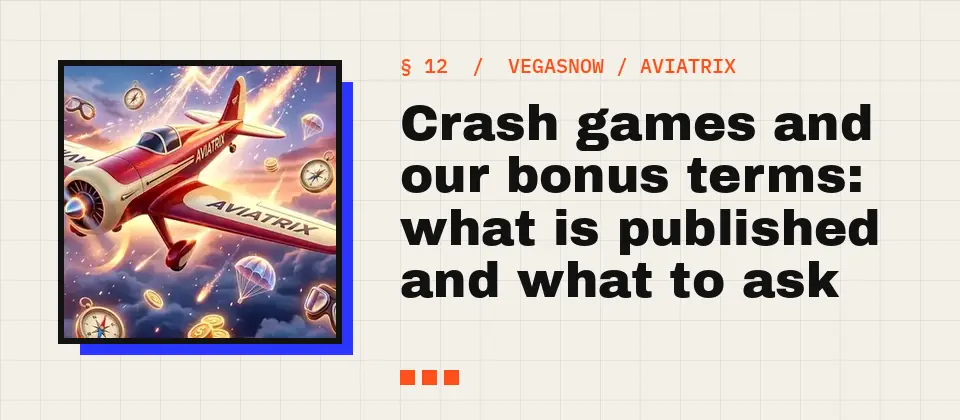
Before you take a bonus with Aviatrix in mind, one fact matters more than the headline offer. Our general terms (version of 26 February 2024) give each game group a weighting: every pokie dollar counts unless the title is on the exceptions list, a roulette dollar counts 25 cents, a blackjack or game-show dollar 10 cents, and baccarat zero. Crash titles do not appear in that list. So we cannot tell you on this page how much an Aviatrix bet counts toward wagering, and you should not assume it counts in full.
The simple fix: ask Live Support or email support@vegasnow.com, name Aviatrix, and ask what contribution applies to your bonus. Keep the written reply before you rely on it.
Why the answer changes everything
Picture a A$60 opening deposit. Stage one of the welcome package matches it at 150%, adding A$90, and the 40x requirement on that A$90 comes to A$3,600 of qualifying play inside seven days, and no single bet may exceed A$8 while the bonus is live. Here is how much real staking that requirement implies under each rate that appears in our terms:
| If a crash bet counted at | Stakes needed | Minimum rounds at the A$8 cap | Rounds per day over 7 days |
|---|---|---|---|
| 100% | A$3,600 | 450 | About 64 |
| 25% | A$14,400 | 1,800 | About 257 |
| 10% | A$36,000 | 4,500 | About 643 |
| 0% | Never cleared | No number works | Not possible |
At full contribution the requirement is large but finite; at a low rate it becomes far more staking than most budgets can carry, and the 3% average cost applies to every dollar of it.
Other bonus rules that touch crash play
- A$8 maximum bet. The cap applies while a bonus is active. If you fly two bets in one round, ask support whether it applies to each bet or to the round as a whole, and stay inside the stricter reading until you know.
- Only one bonus runs at once. Finish or forfeit the current one before a reload can start.
- Winnings cap. Unless an offer states a different figure, what a deposit bonus can turn into is limited to A$5,000.
- Free spins are a separate calculation. Welcome spin winnings carry their own 40x wagering and a A$300 cap.
- You can decline. Any bonus can be declined, which removes the seven-day clock and the bet cap entirely.
The deposit rule that applies with or without a bonus
A separate account rule sits under every deposit, bonus or not: stake it three times over before cashing out, otherwise a withdrawal may be declined or carry a processing fee. For the A$60 example, that is A$180 of bets first.
Our suggestion for Aviatrix fans
If crash games are most of what you play, the cleanest route is often to decline the welcome bonus and play on your own deposit, unless support confirms a contribution rate that suits you. Our bonus page lays out the whole AU$8,000 and 500-spin package over four deposits (codes VEGAS2 to VEGAS4 unlock stages two, three and four), and how the codes work is on our promo code page.
The same caution applies to loyalty points. Points are published for pokies at one per A$25 staked, for roulette at one per A$100, and A$250 of blackjack or baccarat earns one point. Crash games are not on that list, so ask support how Aviatrix play is treated if points matter to you. The provider's XP tournament, covered above, runs separately from both.
Bankroll planning in A$: three sessions worked out

Settle four numbers before the first take-off: a session budget, a stake per round, a stop-loss and a stop-win. Add a time limit and you have a plan the game cannot talk you out of. The three sessions below are worked out from the 3% average cost and our 70-rounds-an-hour working assumption.
Three example plans
| Plan | Short break | Evening session | Dual-bet session |
|---|---|---|---|
| Session budget | A$45 | A$160 | A$400 |
| Bets per round | One: A$0.30 at 1.60x | One: A$1.50 at 2.00x | Two: A$2.40 at 1.40x plus A$0.60 at 6.00x |
| Total per round | A$0.30 | A$1.50 | A$3.00 |
| Stake as share of budget | Under 1% | Under 1% | Under 1% |
| Session length | 30 minutes, about 35 rounds | 60 minutes, about 70 rounds | 60 minutes, about 70 rounds |
| Total staked | A$10.50 | A$105 | A$210 |
| Average cost at 3% | About A$0.32 | About A$3.15 | About A$6.30 |
| Stop-loss | Down A$15 | Down A$50 | Down A$120 |
| Stop-win | Up A$12 | Up A$40 | Up A$100 |
A stake under 1% of the budget is deliberately small. The A$45 plan can absorb 150 losing rounds before the money runs out, which means the stop-loss, not bad luck, ends the session. The evening plan's typical swing over its 70 rounds is around A$12.50 either side of the average, so the A$50 stop-loss comes into play only on a genuinely poor night. The dual-bet plan is Setup 1 from the dual-bet section, doubled.
Rules that make the numbers stick
- Write the four numbers down before you open the game, on paper or in your phone's notes.
- Set the stake and exits once, during the first betting window, and leave them.
- Start a timer outside the game. When it rings, finish the round in progress and stop.
- Stop at either limit. A stop-win matters as much as a stop-loss: a balance left in the account is still in play.
- Back it up in your account. A deposit limit set in your VegasNow account enforces the plan on the days your own resolve is thinner.
Getting money out when you finish ahead
| Route | Smallest request | Largest request |
|---|---|---|
| Bank: Inpay, PayAnyBank or Wire | A$300 | A$6,000 |
| USDT (crypto example) | 20 USDT | 4,000 USDT |
| MiFinity e-wallet | A$30 | A$4,000 |
| Account cap per UTC day / week / month | A$6,000 / A$12,000 / A$42,000 | |
A win larger than those caps cannot leave in one go, and big sums can be split into instalments. Expect an identity check before your first payout, and have your documents ready to avoid delays. The cashier calls payments instant, yet our account checks always happen first.
Two practical points for small sessions. First, method minimums: bank transfers start at A$300 and MiFinity at A$30, so a A$12 gain is best withdrawn together with the rest of the balance rather than on its own. Second, the account rule that deposits are wagered 3x before withdrawal: a A$45 deposit needs A$135 of bets, while the short-break plan stakes only about A$10.50. Spread over several sessions that is no issue, but if you intend to cash out after one short session, read how the rule and its possible fee work on our withdrawal page first.
Aviatrix on your phone
No download stands between you and Aviatrix: the game loads in a web page on a laptop or a phone. VegasNow works the same way. There is no listing for us on the App Store or Google Play and we never hand out APK files; Safari or Chrome takes you to our site, and Aviatrix launches from the lobby once you are signed in.
An app-style icon in a few taps
- iPhone or iPad: in Safari, confirm you are on our real address, press Share and pick Add to Home Screen.
- Android: in Chrome, press the three-dot More menu and choose Install, or Add to Home screen on older versions.
The icon simply opens our mobile site full screen. Your balance, limits and settings stay in your account, not on the device. Any page pushing a "VegasNow app" download file is not ours, and our mobile page explains how to tell the difference.
Small-screen habits worth building
- Set exits before take-off. A mis-tap or a slow thumb on a phone costs a full stake. An auto cash-out entered during the betting window takes your thumb out of the timing.
- Check both bet panels. On a narrow screen it is easy to miss that the second bet is still armed from the previous round.
- Use a steady connection. If a dropped signal affects a flight, note the time and round number from the history and contact support with them.
- Mind the anywhere effect. A casino in your pocket is open on the bus, in bed and at 2am. Our account limits travel with you, so set them on desktop or mobile before you need them.
Turning on your phone's own screen-time limit for the browser gives you a second, separate stop that the game cannot override.
Finding Aviatrix in our lobby, plus five related games
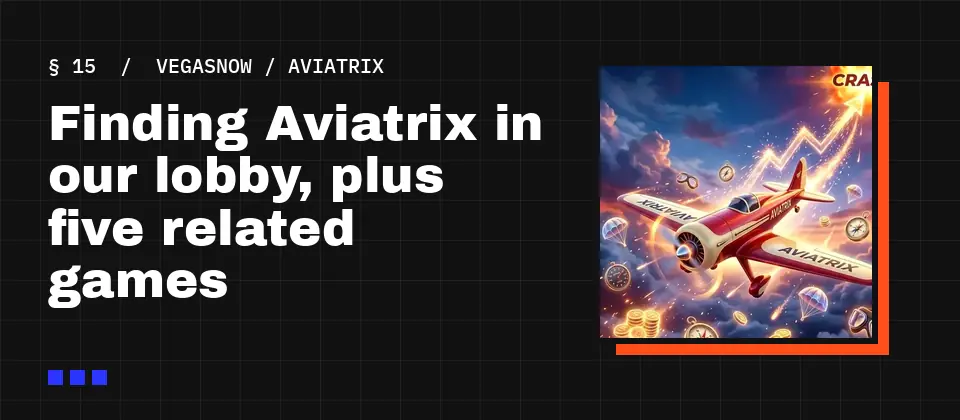
Our casino lobby holds more than 11,000 games, from pokies and live tables to crash and instant titles, so search is the quickest route to a specific game.
- Sign in and open the casino lobby.
- Search "Aviatrix" by name, or narrow the list with the provider filter.
- Check the loading screen shows Aviatrix, then use the info panel to check the return and bet limits on your account.
- Tap the star on the game card to add it to Saved. Saved games are kept on that device and browser, as a personal shortlist.
If a search comes back empty, the title may not be open to your account or region. A saved card is a shortcut, not a guarantee that a game is available.
Five games that suit Aviatrix players
| Game | The decision you make | Why try it |
|---|---|---|
| Aviator | When to cash out of a climbing plane | The closest cousin; compare the two rounds side by side |
| Spaceman | When to leave a rising multiplier | The same tension with a space theme |
| Mines | How many tiles to reveal before taking the payout | You set the risk level before the round, not just the exit |
| Balloon | When to stop inflating before it pops | A slower, more hands-on version of the cash-out choice |
| Plinko | Stake and settings before the ball drops | No mid-round decision at all, a useful contrast |
Return, limits and features differ from title to title, so read each game's own page before carrying a habit across.
Predictor apps, signal channels and fake copies

Crash games show their recent results on screen, and that visible history has grown a whole industry of people claiming to read it. No working Aviatrix predictor exists, and none can. The crash point is sealed in a hash before bets are accepted and every flight starts from new seeds, so yesterday's flights say nothing about the next one.
Red flags that end the conversation
- Software of any kind, whether an app, an APK or a browser extension, that says it can reveal the crash point in advance.
- Telegram or Discord groups selling signals, VIP picks or "leaked hash" access, usually backed by doctored win screenshots.
- Requests for your password, session token, seeds or a one-time code. Whoever asks is after your account.
- Guaranteed daily profits, "unbeatable" bots or a doubling script sold for a fee.
- Requests for crypto up front to unlock a predictor.
- Links to look-alike sites whose Aviatrix copy has no fairness panel, no hangar and no tournament menu.
Two tests that settle it
First, someone holding a tool that beat a crash game would use it quietly rather than sell it for a few dollars. Second, the losses from installing such software are usually bigger than any bad exit, because the buyer hands over login details along with the fee.
Real contact from VegasNow comes only via Live Support in the casino or the support@vegasnow.com address. Ignore any other message that asks for your sign-in in our name, and tell us about it through one of those two routes.
Staying in control while you fly
Crash games are quick, continuous and available on any phone, and research on similar products explains why that mix needs care. No study has looked at Aviatrix players specifically, so the findings below come from neighbouring formats.
- Cash-out buttons raise stakes. In experiments by Bennett and colleagues (2024), simply having a cash-out option available increased stakes by 35% within the same participants and by 24% between groups.
- Who uses the exit matters. A 2024 study found less impulsive players used cash-out more, while players experiencing more harm were less likely to leave risky bets.
- Phones speed things up. Interviews with 33 Australians aged 18 to 29 (Hing and colleagues, 2024) described smartphones as prompting impulsive, anywhere, anytime betting.
- Harm is common. A national survey recorded at least one harm from gambling within a year for 14.7% of Australians who gamble, equal to 8.4% of all adults.
Tools in your VegasNow account
- Deposit limits
- Cap what can go in over a period. Set it in your account before your first Aviatrix session.
- Cooling-off
- A pause of your choosing, set from the account or arranged with our support team.
- Self-exclusion
- For a longer stop, message Live Support or email support@vegasnow.com with the period you want, and save the confirmation that comes back.
Signs it is time to stop
- Raising your exit or stake to win back a loss.
- Playing past the timer you set, or not setting one at all.
- Depositing again in the same session after hitting your stop-loss.
- Feeling that a big multiplier is due.
>Gambling Help Online answers 1800 858 858 at any hour, free and confidential, for players and for the people around them. Australia's BetStop register applies to licensed Australian wagering providers and does not include VegasNow, which is why our own exclusion tool is the one to use here. More on our tools and support services is on our responsible gambling page.
Reader questions
Is Aviatrix a slot or a crash game?
Crash game. Nothing spins and there are no paylines. A plane takes off, its multiplier counts up from 1.01x, and you pick the moment to leave. Get out before it falls and you collect stake times the multiplier on screen; hold on past the crash and that bet is gone. Making that exit call every round is what sets it apart from a pokie.
What is the Aviatrix RTP?
The provider states 97.00%, which means a 3% house edge on every bet in the long run, whatever multiplier you aim for. In crash games the return can be configured per operator and no lab certificate for the figure was available to our source, so open the info panel inside Aviatrix to see the version running for your account.
Can I play the Aviatrix demo at VegasNow?
Demo play depends on whether it is enabled for the game and your account. Look for a demo or free-play option on the game tile or in the game window. Where it appears, it uses play credits with the same round structure, which makes it handy for learning the controls. NFT planes, XP and tournaments generally need real-money play.
What is the best auto cash-out for Aviatrix?
No setting is best on average. Under a 97% return, the odds of the plane getting to any target are close to 0.97 over the target, so every exit costs the same 3% per round. Low exits such as 1.25x win about 78% of rounds with small gains; high exits win rarely but pay more. Choose the ride that suits your budget, then leave it alone.
Do Aviatrix predictor apps or signal groups work?
No. Each crash point is sealed in a hash before bets are taken and every flight uses fresh seeds, so past results reveal nothing about the next one. Predictor apps, Telegram signals and paid bots are scams, and many are designed to steal your login. Never share your password, seed values or one-time codes with anyone.
How are Aviatrix tournament prizes shared?
Players who fly their own NFT plane on at least one real-money bet in a day are eligible. The next day, 25% of those planes are drawn at random and split that day's pool in proportion to their XP. The widely quoted €1,500,000 pool and 25% rule come from the December 2023 to February 2024 season, so check the current season inside the game.
Does upgrading my plane improve my chances?
No. Liveries, colourways, parts and levels are cosmetic. Every plane in a round flies on the same crash point, which is fixed from seeds before betting opens. Your plane's XP does matter in one place: it decides how large a slice you receive when your plane is picked in a provider tournament.
Do Aviatrix bets count toward the VegasNow welcome bonus?
Crash games are missing from the contribution rates we publish, which cover pokies, roulette, blackjack, game shows and baccarat. Before relying on Aviatrix to clear a bonus, ask Live Support or support@vegasnow.com which rate applies and keep the written answer. The A$8 maximum bet applies while any bonus is active, and turning a bonus down is always an option if you prefer to play with deposited money only.
Can I play Aviatrix for real money in Australia at VegasNow?
Adults aged 18 and over can open a VegasNow account and play Aviatrix in A$. Our operator, Just Entertainment B.V., holds Curaçao Gaming Authority licence OGL/2024/164/0246, and we have no Australian licence, so whether you may play from your state is a question for you to check before depositing. Funding is by card, MiFinity, Cashtocode or crypto, inside the published ranges.
How much should I stake per round in Aviatrix?
Small enough that a long losing run cannot end your session. Keeping each round under about 1% of your session budget is a sound starting point: on a A$160 budget that is A$1.50 or less. Over 70 rounds at A$1.50, the average cost is about A$3.15, while the normal swing either way is around A$12.50.
 Coin Volcano3 Oaks Gaming
 Tiger Gems3 Oaks Gaming
 Sunlight Princess3 Oaks Gaming
 BlackjackVegasNow lobby
 PlinkoVegasNow lobby
 BalloonSmartSoft Gaming
 RouletteVegasNow lobby
 StarburstNetEnt
 AviatorSpribe
 SpacemanPragmatic Play
 MinesVegasNow lobby
 Sweet BonanzaPragmatic Play