
Plinko in brief: four choices, then one random draw
Every Plinko game in our lobby comes down to four decisions that belong to you and one outcome that does not. You decide how many rows of pins the ball has to pass, which risk ladder the pockets pay, how much each drop costs and when the session ends. The game decides the pocket. The rest of this page hangs off that split, so it helps to have it straight before you look at a single multiplier.
The four settings you control
| Your choice | What it changes | What it leaves untouched |
|---|---|---|
| Rows (any count between 8 and 16 with BGaming, or 12, 14, 16 with Spribe) | How many pockets there are, how tall the top multiplier is and how rarely the edges are reached | The long-run return, which stays close to the published RTP |
| Risk level | How the payout ladder is spread: a flat ladder near 1×, or a low floor with tall edges | The chance of the ball reaching any particular pocket |
| Stake per drop | The money on the line each round and your expected cost per hour | The odds of any pocket and the share the game keeps |
| Stop point | The most you can lose and how long you sit at the board | The next drop, which never "owes" you anything |
Facts worth having before the first ball
- The falling ball is decoration
- The landing pocket is fixed by the random number generator, or by the provably fair seeds, before the animation starts. Aim, timing and tap speed have no influence at all.
- There is more than one Plinko
- BGaming's Plinko publishes a 99% RTP and a 1,000× top pocket. Spribe's Plinko Classic publishes 97% and stops at 555×. Read the studio name before you trust any number.
- Most high-risk drops lose money
- On 16 rows at high risk, the five middle pockets all pay 0.2×. Between them they catch 78.99% of drops, so roughly four balls in five hand back one fifth of the stake.
- The edges are genuinely rare
- A 16-row board has 65,536 equally likely routes for the ball, and exactly one of them ends in each outer pocket.
- Settings shape the ride, not the price
- On BGaming's ladders, every combination of rows and risk we worked through comes out between 98.9% and 99.1% expected return. You are choosing how bumpy the trip feels, not what it costs on average.
- Provably fair proves honesty, not profit
- You can confirm that a drop was settled without interference. That check tells you nothing about whether the next one will pay.
- Bonus money needs a second look
- Our general terms leave instant games off the published contribution list, and while any bonus is live, no single drop may go above A$8.
Where our figures come from
The odds of each pocket follow from counting the routes a ball can take through the pins. Anybody can repeat that count with a calculator or a spreadsheet, and we show you how further down. The multipliers come from the published ladders for BGaming's board, the version that runs from eight to sixteen rows. Spribe's ladders are different and top out lower, so we flag them separately wherever it matters.
When we quote an expected return, a spread of results or the chance of a losing streak, that figure is our own arithmetic on those ladders, laid out step by step so you can check it. The info panel inside the game you launch always has the final say on the RTP of that exact build. If it ever shows something different from this page, the panel wins.
How to use this page
New to the board? Read how the pins work and the section on rows first, then try the practice exercise in the demo section if a demo is offered for your account. Already playing and wanting to size your stakes or plan an exit? Skip ahead to the stake and stop-point decisions, which include sessions worked out for budgets of A$45 and A$120. Got a bonus sitting in your balance right now? Read the bonus section before your next drop, because the A$8 cap and the unpublished contribution rate both affect what you do next.
One more thing before the detail. Plinko is a game with a built-in cost. The maths below can tell you the size of that cost and how it is likely to arrive, but no setting removes it. Play at VegasNow is for adults aged 18 and up, and the account tools covered near the end of this page are there to keep the cost at the level you chose.
Which Plinko is on your screen? The versions side by side

Search for Plinko online and you are really naming a format rather than one game. Several studios have built their own peg boards, each with its own row options, risk labels, payout ladder and RTP. Figures from one board cannot be carried across to another, and much of the muddle you see online comes from people doing exactly that. Before you weigh up a multiplier, check which studio made the board in front of you.
| Feature | BGaming Plinko | Spribe Plinko Classic | Pine of Plinko, by Print Studios | Xmas Plinko, by Gaming Corps |
|---|---|---|---|---|
| Published RTP | 99% | 97% | 96.48% | Set per operator build |
| Top multiplier | 1,000× | 555× | Over 10,000× via its bonus round | Driven by features and jackpot |
| Rows of pins | 8 to 16 | 12, 14 or 16 | Fixed board | Fixed board |
| Risk setting | Low, Normal, High | Green, Yellow or Red ball | Linked to bet tier | Linked to features |
| Extras | None: a pure board | None: no bonus buy, no free spins | Bonus mini-game with multipliers | Seasonal features |
| How each result is settled | Provably fair | Provably fair | Certified RNG | Certified RNG |
| How the studio labels it | Casual or arcade | Board game | Slot hybrid | Slot hybrid |
BGaming Plinko: the 8 to 16 row board
BGaming launched its Plinko in January 2019, and it is probably the board that springs to mind first. You set the rows anywhere from 8 to 16 and choose Low, Normal or High risk, and the pocket labels along the bottom update the moment you change either setting. There is a manual mode for single drops and an automatic mode for a batch, plus a record of recent results. The studio publishes a 99% RTP and lists the game as provably fair. The pocket tables and expected-return sums on this page use BGaming's ladders.
Spribe Plinko Classic: three coloured balls
Spribe takes a different route to the same idea. Instead of a risk dropdown, you choose a ball colour: Green gives the gentlest ladder, Yellow sits between, and Red is the steepest of the three. Rows are limited to 12, 14 or 16. On Green, the outer pockets reach somewhere between about 18 and 35 times the stake depending on the row count; on Yellow, about 55× to 118×; and on Red with 16 rows, the outermost pockets pay 555×, the highest figure anywhere on the board. Spribe publishes a 97% RTP, which works out to a cost three times larger per dollar wagered than a 99% game. Each colour can be run on autoplay, and the game has no bonus buy, no free spins and no gamble step.
Plinko-themed slots and seasonal boards
Some games borrow the peg board look but run on slot maths. Pine of Plinko from Print Studios lists 96.48% and a bonus round that can go past 10,000×, on a fixed board certified by a testing lab. Xmas Plinko from Gaming Corps is a seasonal hybrid with feature multipliers and jackpot mechanics. Neither uses the rows and risk ladders explained on this page, so none of our pocket tables apply to them.
One title in our catalogue, Pond Of Plinko, carries the name too. Its rules, RTP and top win sit in its own info panel; read them there instead of reusing numbers from a different board.
Four checks that identify the board in front of you
- Read the studio name. You will spot it on the tile in our lobby, and it shows up again inside the rules panel after loading.
- Open the row selector. If it goes down to 8, you are not on Spribe's board, which starts at 12.
- Look at the risk control. Words such as Low, Normal and High point to BGaming; coloured balls point to Spribe.
- Find the RTP line in the info panel. That figure applies to the build you are playing, and it outranks anything printed elsewhere, this page included.
Quick sense check: any chart, clip or page that pairs a 1,000× pocket with a 97% RTP has blended two different games. BGaming's board pays up to 1,000× at 99%; Spribe's pays up to 555× at 97%. No single version combines a 97% return with a 1,000× pocket.
Why the version matters to your wallet
Suppose you plan 600 drops at A$0.35 each, a turnover of A$210. On a 99% board the long-run cost of that plan is about A$2.10. On a 97% board it is about A$6.30. The board looks almost identical and the session feels much the same, but the expected bill is three times larger. That is reason enough to check the studio name every time, especially if you switch between versions in one evening.
Open Plinko in our lobby and check the studio name and RTP in the info panel before your first drop.
How the board works, from the first pin to the pocket
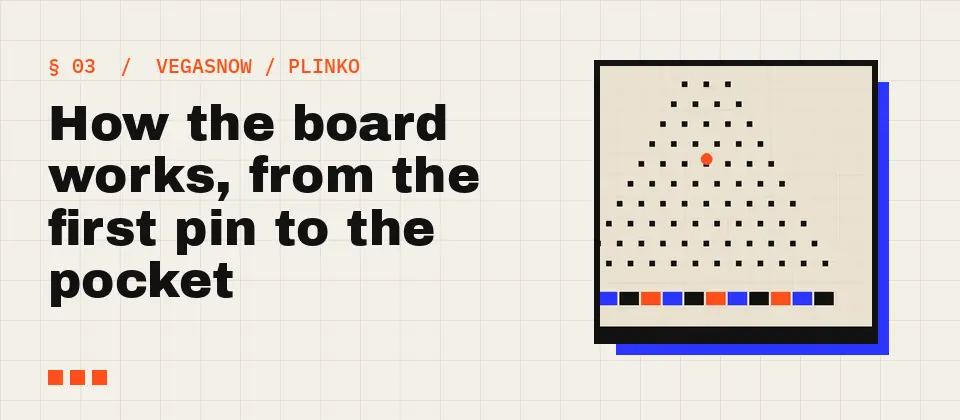
Strip away the colours and the sound effects and a Plinko board is a very old piece of maths with a payout table bolted underneath. Knowing how that maths behaves is the single most useful thing you can bring to the game, because it explains why the middle pockets fill up, why the edges stay empty for long stretches and why nothing you do with your finger alters any of it.
The board in plain terms
Pins are arranged in a triangle, one more pin in each row than in the row above. The ball enters at the top centre. Each time it meets a pin it goes either left or right, with an even chance of each. After passing every row it drops into one of the pockets along the bottom. A board with 16 rows of pins makes 16 of those left-or-right calls on every drop, and it has 17 pockets: one for each possible count of right-hand bounces, from none at all to all sixteen.
That last detail is the key. The pocket a ball lands in depends only on how many times it went right, not on the order. Zero rights puts it in the far-left pocket. Sixteen rights puts it in the far-right pocket. Eight rights, in any order, lands it dead centre.
Why the middle is crowded and the edges are lonely
Take a toy board with four rows. Each drop is a sequence of four bounces, so there are 2 × 2 × 2 × 2 = 16 possible sequences, all equally likely. Count how many sequences produce each number of right-hand bounces:
| Right-hand bounces | Example route | Routes ending here | Share of drops |
|---|---|---|---|
| 0 (far left) | L L L L | 1 | 1 in 16 |
| 1 | L R L L | 4 | 4 in 16 |
| 2 (centre) | R L L R | 6 | 6 in 16 |
| 3 | R R L R | 4 | 4 in 16 |
| 4 (far right) | R R R R | 1 | 1 in 16 |
The 1, 4, 6, 4, 1 pattern is a row of Pascal's triangle, the stack of numbers where each entry is the sum of the two above it. Every Plinko board follows a row of that triangle. Sixteen rows of pins use the row that starts 1, 16, 120, 560 and peaks at 12,870 in the middle, out of 65,536 routes in total. So the far pockets are reached by a single route each, while the centre pocket is reached by 12,870 of them.
The idea is far older than online casinos. In the nineteenth century, a device now called the Galton board was built to show this exact effect: drop enough balls through a field of pins and they pile up in a bell shape. Television made the peg board famous much later, when The Price Is Right introduced its Plinko pricing game in 1983. Online Plinko keeps the look of both and adds three things neither had: adjustable rows, selectable risk ladders and rounds that can be repeated as fast as you can tap.
The animation shows a result that has already been decided
On a physical board, the bounce happens in the real world. Online, it does not. The game first produces the outcome, either from a certified random number generator or from the provably fair seed calculation explained later on this page, and only then draws a ball path that ends in the chosen pocket. The pins, the wobble and the last-second drift towards an edge are all presentation.
Three practical conclusions follow from that:
- No aiming. Wherever the ball appears to start, the release point has no bearing on where it finishes.
- No timing. Tapping fast, slowly or after a pause does not feed into the calculation. The provably fair formula only takes the server seed, your client seed and the drop number.
- No near misses. A ball that brushes past the 1,000× pocket before settling in a 0.2× slot was never heading for the edge. The route was drawn to fit an outcome already set at 0.2×.
Manual drops, automatic drops and the results strip
In manual mode, one tap releases one ball at your current settings. Automatic mode releases a set number of balls in a row without further input, and some versions let you attach stop conditions to the run. BGaming's board also keeps a running record of recent results. That record is handy for checking what happened, but it has no forecasting power: the next drop is calculated without any reference to the last one, the last ten or the last thousand.
How Plinko compares with a pokie
| Point of comparison | Plinko | Typical online pokie |
|---|---|---|
| What you see | A ball falling through rows of pins | Reels, symbols and paylines |
| Can you work out the odds yourself? | Yes, from the row count alone | Rarely, as reel strips are not published |
| Can you change the volatility? | Yes, through rows and risk level | Usually not, apart from some feature buys |
| Bonus rounds and free spins | None on the classic boards | Common |
| Length of a round | Around 1 to 3 seconds, and autoplay can batch them | Around 2 to 5 seconds |
| Skill element | None | None |
Plinko's openness is unusual. On most pokies you trust the published RTP because you have no way of rebuilding it. On a Plinko board you can rebuild the whole distribution from the number of rows and the ladder printed on screen, which is exactly what the next few sections do. That transparency does not make the game cheaper, though. Short rounds, instant feedback and an autoplay button add up to a lot of bets per hour, and the cost of a game is always charged per bet.
Choice one: how many rows of pins
The row selector is the first decision on the board and the most misunderstood. Adding rows does not make the game more generous or less generous. It stretches the board sideways, creates room for taller multipliers at the edges and makes those edges harder to reach. On BGaming's board you can choose any count from 8 to 16; Spribe gives you 12, 14 or 16.
What each row count does to the odds
| Rows | Pockets | Possible routes | Chance of the single centre pocket | Chance of one particular edge pocket | Top high-risk multiplier |
|---|---|---|---|---|---|
| 8 | 9 | 256 | 27.34% (70 routes) | 1 in 256 | 29× |
| 10 | 11 | 1,024 | 24.61% (252 routes) | 1 in 1,024 | about 76× |
| 12 | 13 | 4,096 | 22.56% (924 routes) | 1 in 4,096 | 170× |
| 14 | 15 | 16,384 | 20.95% (3,432 routes) | 1 in 16,384 | 420× |
| 16 | 17 | 65,536 | 19.64% (12,870 routes) | 1 in 65,536 | 1,000× |
Odd row counts, where your version offers them, work the same way with one quirk: the board ends up with two middle pockets of equal size rather than one. On 9 rows, for example, the two centre pockets each take 126 of 512 routes.
Reading the table: two things move, one stays put
Every extra row doubles the number of routes and halves the chance of reaching any single edge pocket. Go from 8 rows to 16 and each edge goes from 1 in 256 to 1 in 65,536, which makes it 256 times rarer. Over the same move, the high-risk ceiling climbs from 29× to 1,000×, roughly 34 times taller. Rarity grows much faster than reward, and the ladders below each pocket are tuned so the overall return lands back at about 99% either way.
The centre loses ground more slowly. On 8 rows the single middle pocket takes just over a quarter of all drops; on 16 rows it still takes almost a fifth. What changes is how many neighbours the centre has. On a 16-row board the middle five pockets together catch 78.99% of drops, which is why the high-risk ladder can afford to pay 1,000× at the edges.
What does not move is the house edge. On BGaming's ladders, the expected return for every row count and risk level sits within a whisker of 99%, as the expected-value section below shows pocket by pocket.
The same jump, seen as waiting time
Probabilities this small are hard to feel, so turn them into drops. If a ball goes down every four seconds, the board handles 900 drops an hour. On 8 rows, an edge pocket on one side or the other turns up on average once every 128 drops, so roughly seven times an hour at that pace. On 16 rows, one edge or the other arrives on average once every 32,768 drops: about 36 hours of nonstop play at the same pace. Averages are not appointments, and real gaps vary hugely either side of them, but the contrast shows why a 16-row session usually ends without seeing an edge at all.
Matching rows to what you actually want
| If you want... | Lean towards | Why |
|---|---|---|
| Long sessions with gentle swings | 8 to 10 rows | Fewer pockets, short gaps between edge hits, smaller top prizes |
| A mix of steady drops and the odd mid-sized hit | 12 to 14 rows | Mid-range ceilings and edge gaps measured in hundreds or low thousands of drops |
| A shot at the biggest multiplier on the board | 16 rows | The only setting with the 1,000× pocket, paid for with long dry spells |
| To learn the game | 8 rows first, then 16 | The contrast between the two teaches variance faster than any table |
Spribe players: the smallest board on Spribe's version is 12 rows, so there is no 8-row option to start from. Begin at 12 with the Green ball if you want the calmest available setting there.
A note on changing rows mid-session
Switching rows between drops is allowed and does no harm in itself, because each drop is calculated on its own. The trap is the reasoning behind a switch. Moving to 16 rows "because the edges have not landed for a while" or dropping to 8 rows "to win some back" treats the board as if it remembers. It does not. Change rows when your plan changes, not when your mood does, and remember that moving up the row count also raises the size of the swings your budget has to absorb.
Choice two: the risk ladder, pocket by pocket
Rows decide how often the ball reaches each pocket. The risk setting decides what each pocket pays. On BGaming's board the three settings are Low, Normal and High, and switching between them relabels every pocket along the bottom without changing the odds of the ball getting there. The tables below put the two halves side by side: the chance of each pocket in one column and the three ladders next to it.
Because the board is symmetrical, each line covers a matching pair of pockets, one on the left and one on the right, and the chance shown is for either of the two. The centre pocket has no twin, so its line covers one pocket only.
16 rows: seventeen pockets, from 0.2× to 1,000×
| Pocket position | Chance per drop (either side) | Low | Normal | High |
|---|---|---|---|---|
| Outer edge | 0.003% (1 in 32,768) | 16× | 110× | 1,000× |
| 1 in from the edge | 0.049% (1 in 2,048) | 9× | 41× | 130× |
| 2 in from the edge | 0.366% (1 in 273) | 2× | 10× | 26× |
| 3 in from the edge | 1.71% (1 in 59) | 1.4× | 5× | 9× |
| 4 in from the edge | 5.55% (1 in 18) | 1.4× | 3× | 4× |
| 5 in from the edge | 13.3% (about 1 in 7.5) | 1.2× | 1.5× | 2× |
| 6 in from the edge | 24.4% (about 1 in 4.1) | 1.1× | 1× | 0.2× |
| 7 in from the edge | 34.9% (about 1 in 2.9) | 1× | 0.5× | 0.2× |
| Centre | 19.6% (about 1 in 5.1) | 0.5× | 0.3× | 0.2× |
Read the High column from the bottom up and the shape of the setting is obvious. The bottom three lines, covering the five middle pockets, all pay 0.2× and between them take 78.99% of drops. The next two lines pay 2× and 4× and take about 18.9% together. Everything from 9× upward shares the last 2.1% or so. Low risk flips that picture: the only pocket that pays under 1× is the centre at 0.5×, about 35 drops in 100 land in a 1× pocket and hand the stake straight back, and the edges top out at 16×.
Normal sits between the two. The middle three pockets, paying less than the stake, catch about 54.5% of drops; the 1× pockets either side catch another 24.4%; and the remaining 21% pay 1.5× or better, up to 110× at the edges.
14 rows: fifteen pockets, up to 420×
| Pocket position | Chance per drop (either side) | Low | Normal | High |
|---|---|---|---|---|
| Outer edge | 0.012% (1 in 8,192) | 7.1× | 58× | 420× |
| 1 in from the edge | 0.171% (1 in 585) | 4× | 15× | 56× |
| 2 in from the edge | 1.11% (1 in 90) | 1.9× | 7× | 18× |
| 3 in from the edge | 4.44% (1 in 23) | 1.4× | 4× | 5× |
| 4 in from the edge | 12.2% (about 1 in 8.2) | 1.3× | 1.9× | 1.9× |
| 5 in from the edge | 24.4% (about 1 in 4.1) | 1.1× | 1× | 0.3× |
| 6 in from the edge | 36.7% (about 1 in 2.7) | 1× | 0.5× | 0.2× |
| Centre | 20.9% (about 1 in 4.8) | 0.5× | 0.2× | 0.2× |
At 14 rows the High ladder pays under the stake on about 82 drops in 100, a little more often than on 16 rows, and its edges are four times easier to reach in exchange for a ceiling of 420× instead of 1,000×. The Normal ladder here is interesting: its centre is as harsh as High (0.2×), but its 1× pockets either side catch a quarter of drops, which softens the session.
12 rows: thirteen pockets, up to 170×
| Pocket position | Chance per drop (either side) | Low | Normal | High |
|---|---|---|---|---|
| Outer edge | 0.049% (1 in 2,048) | 10× | 33× | 170× |
| 1 in from the edge | 0.586% (1 in 171) | 3× | 11× | 24× |
| 2 in from the edge | 3.22% (1 in 31) | 1.6× | 4× | 8.1× |
| 3 in from the edge | 10.7% (about 1 in 9.3) | 1.4× | 2× | 2× |
| 4 in from the edge | 24.2% (about 1 in 4.1) | 1.1× | 1.1× | 0.7× |
| 5 in from the edge | 38.7% (about 1 in 2.6) | 1× | 0.6× | 0.2× |
| Centre | 22.6% (about 1 in 4.4) | 0.5× | 0.3× | 0.2× |
Here is a detail most players never notice. On 12 rows at High risk, five of the thirteen pockets pay under the stake (0.7× or 0.2×), and together they catch 85.4% of drops. That is a higher loss rate per drop than 16 rows at High, where the figure is 79%. The 12-row High ladder makes up for it with 2× and 8.1× pockets that are relatively easy to reach, so its overall return still works out at about 99%. If you assumed fewer rows always meant fewer losing drops, this ladder says otherwise.
8 rows: nine pockets, up to 29×
| Pocket position | Chance per drop (either side) | Low | Normal | High |
|---|---|---|---|---|
| Outer edge | 0.781% (1 in 128) | 5.6× | 13× | 29× |
| 1 in from the edge | 6.25% (1 in 16) | 2.1× | 3× | 4× |
| 2 in from the edge | 21.9% (about 1 in 4.6) | 1.1× | 1.3× | 1.5× |
| 3 in from the edge | 43.8% (about 1 in 2.3) | 1× | 0.7× | 0.3× |
| Centre | 27.3% (about 1 in 3.7) | 0.5× | 0.4× | 0.2× |
The 8-row board is the easiest to read. On every setting, the outer three pairs of pockets pay more than the stake and catch 28.9% of drops between them, so roughly two drops in seven come back bigger than they went in. What risk changes is the size of those wins and the depth of the losses: Low keeps the inner pockets at 1× and 0.5×, while High drops them to 0.3× and 0.2× to pay for a 29× edge.
Spribe's coloured balls
Spribe's Plinko Classic replaces the three named settings with a Green, Yellow or Red ball, and its ladders are its own. They are not reproduced in the tables above, and the BGaming figures do not carry across. What we can say from Spribe's published details: Green's outer pockets reach somewhere around 18 to 35 times the stake depending on rows, Yellow's reach roughly 55× to 118×, and Red's top out at 555× on 16 rows. Pocket odds on any peg board with an even left-or-right bounce are set by the row count alone, so on that basis the chance columns above also describe how often a ball reaches each position on Spribe's 12, 14 and 16-row boards. Read the colour's ladder off the board before you drop, and remember the published return on that version is 97%.
Where the 99% actually comes from
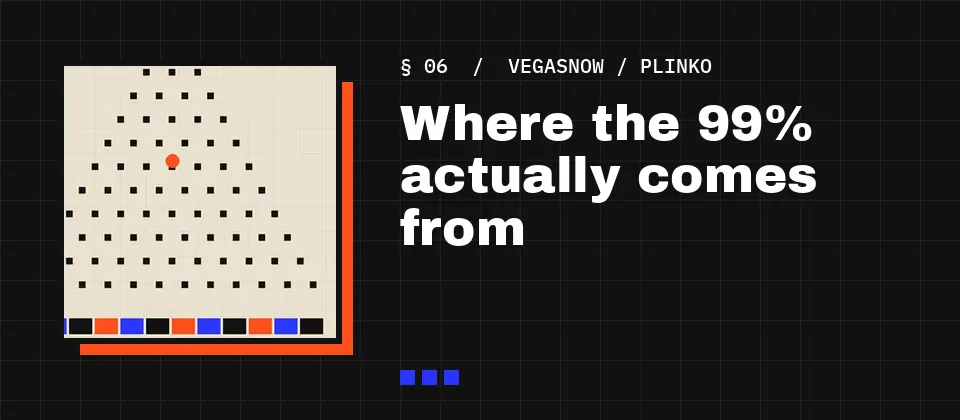
A published RTP is a single number, but on a Plinko board you can open it up and see which pockets supply it. Doing so changes how most people think about the high-risk setting, because the giant edge multiplier turns out to be a surprisingly small part of what the board pays back.
The sum, written out once
Expected return is the payout of each pocket multiplied by its chance, added up across the whole board. For 16 rows at High risk, using route counts out of 65,536:
- Edge pockets: 1,000 × 2 routes = 2,000
- 130× pockets: 130 × 32 routes = 4,160
- 26× pockets: 26 × 240 routes = 6,240
- 9× pockets: 9 × 1,120 routes = 10,080
- 4× pockets: 4 × 3,640 routes = 14,560
- 2× pockets: 2 × 8,736 routes = 17,472
- Five 0.2× pockets: 0.2 × 51,766 routes = 10,353.2
The total is 64,865.2. Divide by 65,536 and you get 0.9898, an expected return of about 98.98% of every dollar staked. That is the published 99% with a little rounding drift, because the multipliers are printed to one decimal place or none, and the sums do not land exactly on a round figure.
Each pocket's share of the return
| Pockets | High risk: multiplier | High risk: cents back per A$1 | Low risk: multiplier | Low risk: cents back per A$1 |
|---|---|---|---|---|
| Outer edges | 1,000× | 3.1 | 16× | 0.05 |
| 1 in from the edge | 130× | 6.3 | 9× | 0.4 |
| 2 in | 26× | 9.5 | 2× | 0.7 |
| 3 in | 9× | 15.4 | 1.4× | 2.4 |
| 4 in | 4× | 22.2 | 1.4× | 7.8 |
| 5 in | 2× | 26.7 | 1.2× | 16.0 |
| 6 in | 0.2× | 4.9 | 1.1× | 26.9 |
| 7 in | 0.2× | 7.0 | 1× | 34.9 |
| Centre | 0.2× | 3.9 | 0.5× | 9.8 |
| Total | 99.0 | 99.0 |
Look at the High column. The famous 1,000× pockets supply about 3 cents of every dollar the board returns over time. The modest 2× and 4× pockets supply about 49 cents between them. The 0.2× pockets, which feel like pure losses, still hand back nearly 16 cents. On a high-risk board you are mostly being paid by mid-sized pockets that arrive every few drops, and the edge is a rare garnish on top.
The Low column tells the opposite story. Close to 62 cents of each dollar comes back through the 1× and 1.1× pockets near the middle, which is why a low-risk session feels like the balance is barely moving. It is moving, slowly and on average downwards, by about one cent per dollar wagered.
Every combination, one expected return
| Rows | Low | Normal | High |
|---|---|---|---|
| 8 | 98.98% | 98.91% | 99.06% |
| 12 | 98.98% | 98.99% | 99.12% |
| 14 | 99.00% | 98.99% | 98.98% |
| 16 | 99.00% | 98.99% | 98.98% |
Twelve settings, and the spread between the cheapest and the dearest is about two tenths of a percentage point. In practical terms, on A$500 of total stakes, the gap between the best and worst cell in that table is roughly A$1. Asking which setting has the best Plinko RTP is therefore the wrong question on this board. They all cost about the same. The right question is which shape of results you are comfortable living with while that cost is collected.
Do the 8-row High sum yourself: (29 × 2 + 4 × 16 + 1.5 × 56 + 0.3 × 112 + 0.2 × 70) ÷ 256 = (58 + 64 + 84 + 33.6 + 14) ÷ 256 = 253.6 ÷ 256 = 0.9906. If your answer matches, you can now check any ladder printed on a board.
Why the studio tunes it this way
Keeping the return flat across settings is a design choice. It lets you pick a volatility profile without accidentally picking a worse price, and it means the board's edge is collected at a steady rate whichever buttons you press. For you, the takeaway is simple: decide rows and risk by the kind of session you want, then decide stake and stop point by what you can afford. The RTP takes care of itself, at roughly one cent per dollar on BGaming's board and three cents per dollar on Spribe's.
Swings, streaks and a spreadsheet you can build in ten minutes
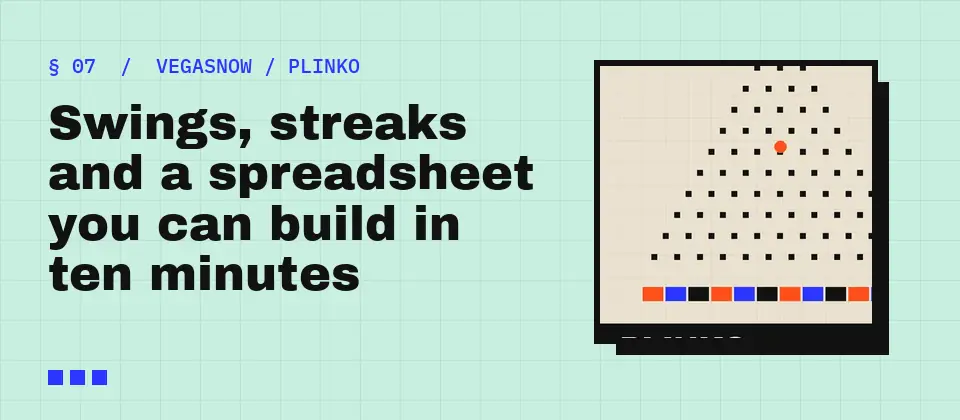
If every setting costs about the same, what actually differs between them is the spread of results around that cost. Statisticians measure spread with the standard deviation; players feel it as the gap between a good night and a bad one. This section puts numbers on that feeling, so you can choose a setting knowing what it is likely to do to a balance.
Spread per drop, setting by setting
The standard deviation of a single drop, measured in stakes, tells you how far a typical result sits from the average. We worked it out for each ladder from the same route counts used above:
| Rows | Low | Normal | High |
|---|---|---|---|
| 8 | 0.56 | 1.24 | 2.67 |
| 12 | 0.39 | 1.29 | 4.38 |
| 14 | 0.32 | 1.36 | 5.58 |
| 16 | 0.33 | 1.47 | 6.57 |
Two patterns jump out. First, risk level dominates: moving from Low to High multiplies the spread by roughly five on 8 rows and roughly twenty on 16 rows. Second, rows only matter much at the high-risk end. On Low, a 16-row board is actually noticeably calmer per drop than an 8-row one, because so many of its drops land in pockets paying 1× to 1.2×.
From one drop to a whole session
Spread grows with the square root of the number of drops, while the expected cost grows in a straight line. Take a session of 400 drops at A$0.15, which is A$60 of total stakes and an expected cost of about A$0.60. The typical swing around that cost looks very different depending on the setting:
| Setting | Expected cost | One standard deviation of the session result |
|---|---|---|
| 16 rows, Low | about A$0.60 | about A$1.00 |
| 8 rows, Low | about A$0.60 | about A$1.67 |
| 12 rows, Normal | about A$0.60 | about A$3.86 |
| 8 rows, High | about A$0.60 | about A$8.01 |
| 14 rows, High | about A$0.60 | about A$16.73 |
| 16 rows, High | about A$0.60 | about A$19.70 |
The working for the last line: 6.565 (spread per drop) × 20 (the square root of 400) × A$0.15 = A$19.70. On a low-risk board the cost is almost the whole story. On a high-risk board the cost is a rounding error next to the swing, and the swing is what you will actually experience.
Why the average misleads on high risk
High-risk results are lopsided. Most sessions lose a little more than the average cost, and a few sessions win a lot, which drags the average up. The middle session, the one you are most likely to have, sits below the average. In a computer model of 200,000 sessions, each starting with 300 stakes and running 400 drops at 16 rows High, the median session finished about 10% down on the starting balance, even though the expected loss was only about 1.4% of that balance. The gap between those two figures is paid out to the minority of sessions that catch a 26×, 130× or better.
That is not a flaw in the game. It is what a high-variance ladder is. But it does mean that "the RTP is 99%, so I'll only lose about 1%" is the wrong expectation for a single evening on 16 rows High. Expect to lose more than that on most evenings, and occasionally to win well.
How often the bigger pockets turn up
For 16 rows at High risk, here is how likely it is to see at least one result of a given size within a set number of drops:
| Result | Average gap | Within 100 drops | Within 400 drops | Within 1,000 drops |
|---|---|---|---|---|
| 9× or better | 1 drop in 47 | about 88% | almost certain | almost certain |
| 26× or better | 1 drop in 239 | about 34% | about 81% | about 98% |
| 130× or better | 1 drop in 1,928 | about 5% | about 19% | about 40% |
| 1,000× | 1 drop in 32,768 | about 0.3% | about 1.2% | about 3% |
The formula behind each cell is one minus the chance of missing on every drop: 1 minus (1 minus p) raised to the number of drops, where p is the chance per drop. For the 1,000× line over 1,000 drops, that is 1 minus (32,767 ÷ 32,768) raised to the power 1,000, which comes to about 3%. Even 22,700 drops only gets the chance of at least one edge hit to about one in two.
Build it in a spreadsheet
- In column A, list pocket numbers 0 to 16 (one per row of the sheet).
- In column B, enter =COMBIN(16,A2)/2^16 and fill down. That is the chance of each pocket. The column should add up to exactly 1.
- In column C, type the ladder for your setting, from one edge to the other, as shown on the board.
- In column D, enter =B2*C2 and fill down. The sum of column D is the expected return per A$1 staked.
- For the spread, put =B2*C2^2 in column E, then take the square root of (sum of E minus the square of sum of D).
- Multiply the expected loss (1 minus sum of D) by your planned stake and number of drops to get the session's expected cost.
Change 16 to your row count and swap in a different ladder, and the same six steps give you any setting on any board whose ladder you can read.
Plinko RTP in dollars: what 99% and 97% cost per hour
RTP, short for return to player, measures how much of every dollar wagered flows back to players across an enormous number of rounds. Whatever is left over is the house edge: 1% on a 99% board, 3% on a 97% one. Neither number promises anything about one evening, but both tell you, with real precision, what an hour of steady play costs on average. Because Plinko rounds are short, that hourly figure depends far more on pace and stake than most players expect.
The cost of an hour, by stake and pace
At a relaxed manual pace you might drop around 250 balls an hour; with quick tapping or autoplay, 500 or more is easy. Here is the average cost of an hour at four stake sizes:
| Stake per drop | Drops per hour | Hourly stakes | Average cost at 99% RTP | Average cost at 97% RTP |
|---|---|---|---|---|
| A$0.10 | 300 | A$30 | A$0.30 | A$0.90 |
| A$0.25 | 300 | A$75 | A$0.75 | A$2.25 |
| A$0.50 | 500 | A$250 | A$2.50 | A$7.50 |
| A$1.00 | 500 | A$500 | A$5.00 | A$15.00 |
| A$2.00 | 600 | A$1,200 | A$12.00 | A$36.00 |
The pattern is worth remembering: turnover, not the stake on any one drop, is what drives the bill. A A$0.50 player who taps quickly can generate more hourly stakes than a A$1 player who drops at half the speed. If you want a game to cost less per hour, lowering the stake and slowing down both work; changing rows or risk does not, because every setting carries about the same edge.
What RTP does not mean
- Not a 99% chance of keeping your money. On 16 rows High, about four drops in five lose 80% of the stake. RTP describes the average over a huge number of drops, not the usual result of one.
- Not a session forecast. Over a few hundred drops on a high-risk ladder, your result can land tens of stakes either side of the average. The previous section puts numbers on that.
- Not a refund schedule. A board that has paid below 99% over the last hour has not built up a debt to you. The next drop is calculated with no knowledge of the last one.
Hot, cold and live RTP displays
Some studios show a live return figure for recent play, sometimes coloured or labelled hot and cold. These are records of what has already happened across a recent window of rounds. They are useful as a transparency tool, because over very large samples the realised figure should drift towards the published one. They are useless as a timing tool. A game showing "cold" is not about to warm up, and a "hot" game is not about to run dry. If a display tempts you to wait for a better moment to drop, close it and stick to your plan.
Why different pages quote different RTPs
You will see Plinko RTPs quoted anywhere from the mid-nineties to 99%. Three causes explain nearly every mismatch:
- Two games blended into one. A 97% figure belongs to Spribe's board and a 99% figure to BGaming's. A page pairing 97% with a 1,000× pocket has mixed them up.
- Several builds of one game. Some studios release more than one certified RTP version of a title, and the casino running it selects one. The build in our lobby is the one whose figure appears in the game's own info panel.
- Rounding. Ladders printed to one decimal place produce sums slightly either side of the headline, which is why our own working gives figures from 98.91% to 99.12% for a board published at 99%.
The rule we suggest: before your first drop on any version, open the info panel, find the RTP line and note it down along with the studio name. If you switch games mid-session, do it again. It takes ten seconds and settles every argument about the number.
Turning RTP into a budget decision
The most practical use of RTP is to price a session before it starts. Multiply your planned drops by your stake and by the house edge. A plan of 800 drops at A$0.30 is A$240 of stakes; at 99% the average cost is A$2.40, at 97% it is A$7.20. If that cost feels fair for the time you expect to spend, the plan is sound. If it does not, reduce the stake or the drop count rather than hoping variance will cover the gap. Then remember the previous section: on high-risk ladders, the result of any one session will wander well away from that average, so set your loss limit with the swing in mind, not just the cost.
Checking a drop yourself: provably fair, step by step
Both BGaming's and Spribe's boards are listed as provably fair. That phrase has a narrow, precise meaning: you can prove, after the fact, that the result of a drop was fixed before you placed it and was not altered afterwards. It is one of the few places in a casino where you do not have to take anybody's word for anything. This section explains the moving parts, walks through a check and is honest about what the check does and does not show.
The three ingredients
- Server seed
- A secret value created by the game server. Up front you only get to see a SHA-256 digest of it: a scrambled stand-in that locks the server into that value while keeping the value itself hidden.
- Client seed
- Your contribution, generated by your browser and normally open to editing. Because the server cannot know your client seed in advance, it cannot pre-arrange your outcomes.
- Nonce
- A running tally of bets placed under the current seed pair, ticking up by one per drop: 1, 2, 3 and onwards. It gives every drop a unique input.
How those ingredients become a pocket
All three go into HMAC-SHA256. The secret server value acts as the key; your seed with the drop count attached forms the message. Out comes a block of bytes, and those bytes are turned, a few at a time, into numbers between 0 and 1. Each number is compared with one half: below it means one direction, above it means the other. A 16-row board needs 16 of those decisions, and counting the right-hand ones gives the pocket number, which the ladder for your chosen risk level then turns into a payout. Exact byte handling can differ between studios, so always follow the description in the fairness section of the game you are checking.
Running a check
- Before you play, copy the hashed server seed shown in the game's fairness settings, and note your client seed. Change the client seed to something of your own if you like.
- Drop balls normally. Pick one drop to audit and jot down its nonce together with the pocket it hit.
- Rotate the seed pair. Starting a new pair makes the game reveal the old server seed in plain text.
- Hash the revealed seed in a SHA-256 calculator of your choosing. Compare the digest, character for character, against what you saved at the start. Any difference means the server value was swapped, and the check has failed.
- Rebuild the drop. Feed HMAC-SHA256 the now-public server value as its key, and your seed plus that drop's count as its message, laid out exactly as the game's notes specify.
- Convert and count. Translate the bytes into a run of left and right bounces following the fairness notes, tally the rights, and see whether that pocket number matches the one on screen.
If a check fails: stop playing that game, keep a copy of the seeds, the nonce and the time, and send them to support@vegasnow.com so the result can be looked into. A mismatch is a serious finding, and the details you saved are what make it possible to investigate.
What a passing check proves, and what it does not
| What you might wonder | Can a seed check settle it? |
|---|---|
| Had the outcome been locked in before my stake went down? | Yes |
| Could anyone have altered it once my stake was placed? | Yes: a passing check shows nobody did |
| Is the ladder on screen the one used to pay me? | Yes, if you rebuild the pocket and read its multiplier off the ladder |
| Is the published RTP correct? | Not directly. That comes from summing the ladder, as shown earlier, or from a testing lab's report |
| Will the next drop pay? | No. Nothing can tell you that |
| Is the house edge smaller because it is provably fair? | No. The edge is exactly the same |
Put simply, provably fair proves process, not generosity. It tells you the game did what it said it would. It does not make the board cheaper, and a verified losing streak is still a losing streak.
Certified RNG games
Plinko-themed slot hybrids such as Pine of Plinko use a certified random number generator rather than player-checkable seeds. There, the assurance comes from a testing laboratory's certificate, which should name the lab, carry a date and identify the version of the game it covered. You cannot rerun one of those results yourself, so the info panel and the studio's published details are where to look.
Is it worth doing?
Few players check every drop, and you do not need to. Checking one or two drops the first time you play a version is a sensible habit: it confirms you understand where the result comes from, and it removes any lingering suspicion that the board is "reading" your stake or your timing. After that, keeping a note of your seed pair before a long session is enough to let you check later if something ever looks wrong.
Plinko demo or real money: what each mode can teach you
A Plinko demo, where a studio offers one, runs the same board, the same ladders and the same odds as the paid game, using play credits instead of your balance. That makes it a genuinely useful place to learn. It also hides the one thing that shapes real sessions most, which is the feeling of losing your own money. This section covers both sides, plus the practical steps between them.
Is there a demo in our lobby?
Demo availability is set per game and per studio, and it can vary by account and region. Where a demo or fun mode is switched on for a Plinko version, the option appears when you open the game from our lobby. If you only see a real-money launch, that version is not offered in demo for you at the moment. Better to say so up front than to promise a free mode you then cannot find.
A 20-minute practice routine
If a demo is available, use it with a purpose rather than as free entertainment. This routine teaches more about variance than any table:
- Confirm you are in demo. The balance should be clearly marked as play credits. If it shows Australian dollars from your account, you are in real-money mode.
- Set 8 rows and Low risk. Drop 60 balls by hand and keep a tally. Expect roughly 16 in the 0.5× centre, about 26 in the 1× pockets and around 17 that pay more than the stake.
- Switch to 16 rows and High risk. Drop another 60. Expect about 47 to land on 0.2×, around 11 on 2× or 4×, and one or two on 9× or better. Watch how differently the credit balance moves.
- Try autoplay with a stop. If the version offers stop conditions, set a batch of 100 drops that halts after losing a fixed share of the demo balance, and check that it actually halts.
- Write down three things: the deepest dip in the balance, the longest run without a result above 1× and the biggest single result. These are the numbers that should shape your real-money plan.
- Stop when the timer ends. Twenty minutes is plenty. Beyond that, practice turns into habit-forming play with no lesson attached.
What a demo can and cannot show you
| Item | Visible in demo? | Comment |
|---|---|---|
| Row and risk controls | Yes | The full range of the version |
| Ladders for each setting | Yes | They update on the board as you change settings |
| How a balance rises and falls | Yes, with a caveat | Practice credits tend to dwarf any sensible real budget |
| Manual and automatic modes | Yes | Including stop conditions where the version has them |
| Results history | Yes | Informative about the past, silent about the future |
| Seed checks | Sometimes | Not every demo exposes the provably fair settings |
| Bonus wagering, verification, withdrawals | No | These only exist on a funded account |
| The pull of a losing streak | No | The biggest gap between practice and real play |
The demo balance trap: a demo might start you with thousands of credits against a default stake of one. A strategy that survives 16 rows High on that cushion can sink a real balance of 150 stakes in a single bad run. When you move to real money, size your stake for your actual budget, not for the demo.
Moving to real money at VegasNow
Playing for money means opening an account, which only people 18 or older may hold. Look up the rules that cover your location before any deposit: VegasNow holds a licence issued in Curaçao, not one granted by any Australian authority. Should you go ahead, the route runs as follows:
- Sign in or register. Our login and account page covers the sign-in steps and what to do if you are locked out.
- Set a deposit limit first. Do it in the account before the first deposit, while you are thinking clearly about your budget.
- Deposit. Cards take between A$30 and A$10,000 per payment; MiFinity between A$30 and A$4,000; Cashtocode from a A$25 minimum to a A$400 maximum; crypto such as BTC, ETH or USDT is also on the list. If you want the first welcome stage, A$20 is its minimum, but card and MiFinity still need their own A$30 minimum.
- Find the game and read the info panel. Check the studio, the RTP line and the stake range before choosing rows and risk.
- Know the cash-out rules before you need them. Our account rules expect every deposit to be staked three times over before withdrawal; skip that step and a fee, or a refusal, may follow, and most players are asked to confirm their identity around the time of a first payout. Our withdrawal page has the methods and limits.
Go to the VegasNow lobby to see which Plinko versions are live for your account.
Choice three: sizing your stake against your budget
Rows and risk set the shape of the results. The stake sets their size in dollars. Get it wrong and even a calm setting can empty a balance faster than planned; get it right and a high-risk board becomes a choice you can afford rather than a gamble on the next few drops. The simplest way to think about it is in stakes: how many of your chosen bet does your session budget hold?
Count your budget in stakes, not dollars
A A$45 budget at A$0.15 a drop holds 300 stakes. The same A$45 at A$0.45 holds 100. That single number, the budget divided by the stake, decides how much bad luck a session can absorb before it ends early. It also makes your experience portable: 300 stakes behaves the same whether each stake is 15 cents or a dollar fifty.
Session one: A$45 at A$0.15 a drop, 400 drops
To show what different settings do with the same money, we modelled 200,000 sessions per setting on a computer, each starting at A$45 with a A$0.15 stake and running 400 drops (A$60 of total stakes), using BGaming's ladders and the route odds from earlier. These are not records of real play. They are the maths of the board, run many times over:
| Setting | Middle result | 8 in 10 sessions finish between | Sessions finishing ahead |
|---|---|---|---|
| 8 rows, Low | A$44.31 | A$42.30 and A$46.58 | about 35% |
| 16 rows, Low | A$44.33 | A$43.20 and A$45.68 | about 25% |
| 12 rows, Normal | A$44.04 | A$39.75 and A$49.50 | about 40% |
| 16 rows, Normal | A$43.76 | A$39.57 and A$49.91 | about 38% |
| 14 rows, High | A$41.01 | A$30.30 and A$57.57 | about 35% |
| 16 rows, High | A$40.26 | A$31.56 and A$58.77 | about 32% |
All six settings carry the same average cost of roughly 60 cents. What differs is everything else. On 16 rows Low, almost every session lands within a dollar or two of A$45, and only a quarter finish in profit, because so many drops pay exactly 1× or a touch more. On 16 rows High, the middle session is nearly A$5 down, but the top tenth of sessions finish above A$58 thanks to the occasional 26× or 130×. About 1.4% of those 16-row High sessions doubled the A$45 within 400 drops. With 300 stakes in hand, essentially none of the sessions on any setting ran the budget dry before the last drop.
Session two: A$120 at A$1.20 a drop, 400 drops
Now keep the drop count but shrink the cushion to 100 stakes. Total stakes jump to A$480 and the average cost to about A$4.80:
| Setting | Middle result | 8 in 10 sessions finish between | Ran out before drop 400 |
|---|---|---|---|
| 8 rows, Low | A$114.60 | A$98.28 and A$132.60 | practically never |
| 12 rows, Normal | A$112.44 | A$78.00 and A$155.76 | practically never |
| 16 rows, High | A$82.08 | A$6.96 and A$230.16 | about 9 sessions in 100 |
With only 100 stakes behind it, the 16-row High session becomes a coin toss with sharp edges. The middle result is down by a third of the budget, one session in ten finishes with less than A$7 left, and about nine in a hundred hit zero before the 400 drops are up. At the same time, nearly nine in a hundred double the budget. That is the high-risk ladder doing exactly what it is built to do, and it is why the stake you pick for 16 rows High should be much smaller relative to your budget than the stake you pick for 8 rows Low.
Rules of thumb from the numbers
| Setting | Budget should hold at least | Example on a A$60 budget |
|---|---|---|
| Low risk, any rows | 100 stakes | A$0.60 a drop or less |
| Normal risk, 12 to 16 rows | 200 stakes | A$0.30 a drop or less |
| High risk, 12 to 16 rows | 300 to 400 stakes | A$0.15 to A$0.20 a drop |
These are cushions for a session of a few hundred drops, not guarantees. They lower the chance of the budget running out before you have had the session you planned. They do not change the average cost, which stays at roughly one cent per dollar staked on BGaming's board.
Stake limits you will run into
- The game's own range. Each version has a minimum and maximum stake, shown in its bet field. Check it before planning a stake that may not exist.
- The A$8 bonus ceiling. While any bonus is active, no single drop may exceed A$8. Plan around that if you are playing with bonus funds.
- Your deposit limit. If you have set one, it caps how much can go into the account over its period, whatever the stake.
Keep it flat. Pick one stake for the session and leave it there. Flat stakes make the cost predictable (stake × drops × house edge) and stop a bad run turning into a bigger bet. The next section shows what happens when stakes chase losses.
Choice four: deciding where you stop
Of the four choices, this is the one that most decides how a Plinko session ends, and the one most often left until it is too late. A stop point chosen before the first drop is a plan. A stop point chosen during a losing run is a negotiation with yourself, and the maths below shows why those negotiations tend to go badly on a fast game.
Four kinds of stop, and when each one fits
| Stop type | How it works | Example |
|---|---|---|
| Loss limit | End the session when the balance falls by a set amount | Stop if A$45 becomes A$30 |
| Time limit | End after a fixed time, whatever the balance | Forty minutes, phone alarm set |
| Drop count | End after a fixed number of balls | 400 drops, then close the game |
| Win goal | End if the balance reaches a target | Stop and withdraw if A$45 reaches A$67.50 |
A loss limit and a time limit together cover most situations. The drop count is a good extra on autoplay, because it is easy to lose track of hundreds of quick rounds. A win goal is optional but useful: it gives a good session a clear ending instead of letting it drift back down. For perspective, in the A$45 model from the previous section, a A$67.50 win goal on 16 rows High was reached in about 6 sessions out of 100 within 400 drops. Nice when it happens, rare enough that it should never be the reason you play.
Losing runs are normal, and longer than they feel
On high-risk ladders, most drops pay under the stake, so long runs of sub-stake results are routine. Here is the chance of seeing at least one run of a given length during a 500-drop session:
| Run length (drops in a row under 1×) | 8 rows, High | 16 rows, High | 12 rows, High |
|---|---|---|---|
| 15 or more | about 58% | about 96% | almost certain |
| 20 or more | about 14% | about 61% | about 97% |
| 25 or more | about 3% | about 25% | about 77% |
| 30 or more | under 1% | about 8% | about 47% |
Read the 12-row column twice. Because that ladder pays under the stake on 85.4% of drops, a 500-drop session has close to an even chance of containing 30 sub-stake results in a row. None of these runs mean the board has gone cold or that a big hit is building up. Each drop is a fresh draw, and the drop after a run of 25 losers has exactly the same odds as the first drop of the night. If your stop point is "when it turns around", these numbers explain why that point may arrive very late.
What doubling after losses really costs
The best-known betting system, doubling the stake after each loss so that one win recovers everything, runs into trouble on Plinko faster than almost anywhere else. Start at A$0.20 on 16 rows High:
| Drop in the losing run | Stake | Total staked so far |
|---|---|---|
| 1 | A$0.20 | A$0.20 |
| 4 | A$1.60 | A$3.00 |
| 7 | A$12.80 | A$25.40 |
| 9 | A$51.20 | A$102.20 |
| 11 | A$204.80 | A$409.40 |
Pick any stretch of ten consecutive drops on that board and the odds that all ten miss the stake are 0.79 multiplied by itself ten times, roughly 9.5%; across 500 drops, meeting such a stretch somewhere is close to certain. So the doubler will almost surely need the eleventh stake at some point, which is 1,024 times the first. With a bonus active, the sequence breaks even earlier: the seventh stake, A$12.80, is already above the A$8 maximum bet. And because the most common result is a 0.2× return rather than a clean loss, and the most common win is only 2×, the neat "one win recovers all" logic never quite works out in the first place.
Gentler systems, such as adding one unit after a loss and taking one away after a win, avoid the explosive stakes but still raise your total turnover in losing stretches, and with it the expected cost. No pattern of stakes changes what each dollar staked is worth. Only the amount wagered changes.
Making your stop point stick
- Write it down before you start. A number on paper is harder to argue with than a number in your head.
- Use autoplay stop conditions where the version offers them, and always set a drop count on any automatic batch.
- Set a phone alarm for your time limit. Fast rounds compress the sense of time; an alarm does not.
- Withdraw a win goal, do not just note it. Money still in the balance is easy to drop back into the board.
- Back it up with account tools. A deposit limit set in your account holds even on nights when your resolve does not. Every tool, with the steps for turning it on, sits on our responsible gambling page.
Plinko and bonus money: read this before you drop
Bonuses and Plinko need a careful pairing. Our offers come with wagering, a time limit and a stake ceiling, and the published contribution list does not include instant games. None of that stops you playing Plinko; it just means you should know the rules before the first bonus-funded ball goes down.
The welcome stages at a glance, priced in wagering
| Stage | Wagering needed on a maxed bonus (40x) | Biggest bonus available | Match, and code if any | Deposit that maxes it |
|---|---|---|---|---|
| First | A$60,000 of stakes | A$1,500 | 150%, nothing to type | A$1,000 |
| Second | A$80,000 of stakes | A$2,000 | 100% with VEGAS2 | A$2,000 |
| Third | A$80,000 of stakes | A$2,000 | 50% with VEGAS3 | A$4,000 |
| Fourth | A$100,000 of stakes | A$2,500 | 25% with VEGAS4 | A$10,000 |
Across the four stages the package reaches A$8,000 in bonus money plus 500 free spins, and each stage accepts deposits from A$20 (card and MiFinity carry a A$30 method minimum). You do not have to fill any cap: a smaller deposit simply earns a smaller bonus with proportionally smaller wagering. Full details sit on our bonus page, and the codes are explained on the promo code page.
The rules that touch every Plinko drop
- 40x the bonus, within 7 days. The seven days count from the moment bonus money lands.
- A$8 ceiling per bet while bonus money is in play, Plinko drops included.
- Only one bonus runs at once, and turning an offer down is always allowed.
- A$5,000 is the default ceiling on deposit-bonus winnings, where an offer's own terms do not set another figure. Even a 1,000× edge hit made with bonus funds falls under that ceiling.
The contribution question
Our general terms set out contribution for several game types: pokies count in full (bar listed exceptions), roulette counts 25 cents in the dollar, blackjack and game shows 10 cents, and baccarat nothing. Instant games such as Plinko are not on that list. That leaves three possibilities: they could count in full, count partly, or be excluded. We will not guess on your behalf. Check the terms shown with the offer you hold, or email support@vegasnow.com and ask which rate applies to the Plinko version you plan to play.
Why it matters so much: the rate multiplies the turnover you need. Take a A$75 bonus, which at 40x means A$3,000 of qualifying wagering. Purely as an illustration of the arithmetic:
| If the rate were | Plinko stakes required | Average cost on a 99% board | Drops needed at the A$8 ceiling |
|---|---|---|---|
| 100% | A$3,000 | about A$30 | 375 |
| 25% | A$12,000 | about A$120 | 1,500 |
| 10% | A$30,000 | about A$300 | 3,750 |
| 0% | Wagering would never progress | no figure | no figure |
At low rates, the average cost of clearing can exceed the bonus itself, and seven days may not be enough time anyway. If the rate turns out to be low or zero, the sensible options are to clear the bonus on games that count in full, or to decline it and play Plinko with your own balance and no A$8 ceiling.
One more account rule: bonus or no bonus, the cashier expects deposited money to go through play three times before it comes back out; otherwise a fee may be charged or the payout refused.
Plinko on your phone
Plinko suits a phone almost too well. The board is tall and narrow, the controls fit under a thumb and a round takes a second or two. At VegasNow you play it in the mobile browser. You will not find us in either phone app store, and we do not distribute APK files, so treat any download carrying our name as fake.
Getting set up in a minute
- Open Safari on iPhone or Chrome on Android and go to our site.
- Sign in, then type "Plinko" into the lobby search.
- For an icon on your screen, use the browser's share or menu button and choose Add to Home Screen.
- Open the game, then the info panel, and confirm the studio and RTP before your first drop.
More detail, including what to do after changing phones, is on our mobile app page. Because your balance, limits and bonus status are stored on the account rather than the handset, nothing is lost if you switch devices.
Phone habits worth having
- Use portrait mode. The board fills the screen, and the row and risk controls are easier to read.
- Play on a steady connection. Results are settled on the server, but a dropped signal mid-batch is annoying and easy to misread. Check your balance and history after reconnecting.
- Turn autoplay down, not up. On a phone, a long batch can run while your attention is elsewhere. Keep batches short and always set a drop count.
- Use your phone's own screen-time tools as a second layer alongside the deposit limit in your account.
- Close the tab when you stop. A game left open on a phone is one tap from another session.
The maths is identical on every screen. Rows, ladders, odds and RTP do not change between a phone and a laptop; only the speed at which you can play does, and on a phone that speed tends to be higher.
Finding Plinko in our lobby, and games with a similar feel
Our lobby holds 11,000+ games, so searching is quicker than scrolling. Type "Plinko" into the search box and every title with the word in its name will appear, which may include more than one studio's board as well as other titles carrying the name, such as Pond Of Plinko. Where the lobby offers a provider filter, it narrows the list to a single studio once you know which version you want.
Picking between results
- Studio name on the tile tells you which ladders and RTP to expect.
- Info panel inside the game confirms the RTP of the build you are about to play.
- Row selector range distinguishes BGaming's 8 to 16 board from Spribe's 12 to 16.
- Bonus features listed in the rules mark a Plinko-themed slot rather than a pure board.
Not every title is available to every account or region, so if a version you have heard of does not appear in search, it is not live for you at the moment.
If you like Plinko, you may like these
Plinko belongs to the instant-game family: short rounds, simple screens and results that land in seconds. The games below share that pace, but each hands you a different decision. In Plinko, every choice is made before the ball drops; in several of these, the key choice comes mid-round.
| Game | The round in a sentence | Where your choice comes in |
|---|---|---|
| Mines | Tiles are flipped one at a time on a grid hiding a set number of mines | The mine count up front, then whether to flip another tile or bank the multiplier |
| Balloon | A balloon inflates and its multiplier grows until it bursts | When to cash out before it pops |
| Aviator | A plane climbs with a rising multiplier and can fly off at any moment | When to cash out during the flight |
| Aviatrix | A crash-style round with a climbing multiplier | When to take the multiplier and step out |
| Spaceman | An astronaut-themed crash-style round where the multiplier keeps climbing | Taking the payout in full or in part before the flight ends |
| Plinko | A ball falls through pins into a paying pocket | Rows, risk and stake, all set before the drop |
The mid-round cash-out in crash-style games can feel like control, but the same principle applies as on the peg board: the result is drawn by the game, the published RTP sets the long-run cost, and your real levers are stake, session length and stop point. Each game page explains its own rules and figures. For the wider picture of what sits in our catalogue, see our online casino overview.
Search for Plinko in the VegasNow lobby and open the info panel before you set your rows.
Playing from Australia, and staying in control
Plain facts first. The company behind VegasNow is Just Entertainment B.V., based at Scharlooweg 39 in Willemstad, and our casino runs on the licence numbered OGL/2024/164/0246, granted in Curaçao. No Australian authority has licensed us, and no line here should be read as hinting otherwise. Whether online casino play is allowed for you turns on the law in your own location, which you need to look into before signing up. Nobody under 18 can hold an account. Our Australia page explains how we deal with players in Australia, and the full conditions are in our terms and conditions.
Why a fast game deserves firm limits
Plinko combines very short rounds, instant results, an autoplay button and a board that is always one tap away on your phone. Research into gambling harm keeps pointing at exactly that mix: high-frequency, always-available products can run up large turnover before the player notices. Australia's 2023 parliamentary inquiry into online gambling, titled "You win some, you lose more", treated gambling harm as a public health issue for that reason. The practical answer is to let tools hold the line for you.
Tools in your VegasNow account
- Deposit limits
- Cap what can go into the account over a period. Set one before your first deposit, not after a bad night.
- Cooling-off
- A break from play for a set time, available in the account or by asking support.
- Self-exclusion
- A longer lock on play, set from your account settings, or by writing to support@vegasnow.com.
BetStop and what it covers
>BetStop is the national register that lets people exclude themselves from licensed Australian wagering providers. We do not belong to it, which means signing up to BetStop will not on its own shut a VegasNow account. To stop playing here, switch on self-exclusion from your settings or have support set it up for you, in addition to anything else you decide to do.
Signs it is time to stop and talk to someone
- Sessions keep stretching past the time or the amount you set.
- You raise your stake to win back what you have lost.
- You start to feel a setting or a streak is "due".
- You play to escape stress, boredom or low mood rather than for fun.
- Money meant for rent, bills or food ends up in your balance.
- You keep the size of your play from the people around you.
Recognise one or more of these? Ring 1800 858 858 or visit >Gambling Help Online, where counsellors answer by phone, chat or email at any hour, free and in confidence. Things do not have to be serious before you reach out, and partners, relatives and friends are welcome to use it too.
Reader questions
Can I aim the ball or time my click in Plinko?
No. The pocket is picked by the game's random number generator or, on provably fair versions, by the server seed, client seed and nonce, before the ball appears to move. What you watch is a drawing of an outcome that was settled a moment earlier. Tapping quickly, slowly or at some lucky instant changes nothing, and neither does the order of your drops. The only levers you hold are the rows, the risk level, the stake and the moment you decide to stop.
What is Plinko's RTP, and why do I see different figures?
Two published figures dominate. BGaming's Plinko states 99% and Spribe's Plinko Classic states 97%. Plinko-themed slot hybrids sit elsewhere again: Pine of Plinko from Print Studios lists 96.48%. Some studios also ship more than one RTP build of a single title, so trust the number shown inside the info panel of whichever game you actually launch. At 99%, the long-run cost is about A$1 for every A$100 wagered; at 97% it is about A$3.
What are the odds of landing the 1,000× pocket in Plinko?
On a 16-row board each outer pocket is reached by one path out of 65,536, so one or other edge turns up about once in 32,768 drops on average. That is a long-run frequency, not a timetable. Over 1,000 drops the chance of at least one edge hit is roughly 3%, and it takes around 22,700 drops before that chance passes one in two. Spribe's top 555× payout lives in the same outer pockets, on its 16-row Red setting.
How many rows should I pick on a Plinko board?
Rows change the spread of results, not the house edge. Eight rows gives nine pockets and a compact range: on the high-risk ladder the top pocket pays 29× and turns up about once in 128 drops. Sixteen rows gives seventeen pockets, a 1,000× ceiling and much longer gaps between large hits. For a long, even session, fewer rows on low risk suits you. For a rare big multiplier at the price of long dry spells, more rows on high risk is that trade.
Which Plinko risk level pays back most often?
Low risk. On a 16-row low board, about 80 drops in 100 return at least the stake, although around 35 of those pay exactly 1×, so the balance barely moves. At high risk on the same 16 rows, about 79 drops in 100 return only 0.2×. On BGaming's ladders both settings work out to roughly the same 99% expectation; what changes is how bumpy the path to that average feels.
Can I play a Plinko demo at VegasNow?
Where a studio's demo mode is switched on in our lobby, you will see a demo or fun option when you launch the game. If only a real-money launch appears, that version is not available in demo for your account. A demo runs the same ladders and odds as real play, which makes it a sound place to learn the controls. What it cannot show you is how a losing run feels with your own money, or how wagering, verification and withdrawals work.
Does VegasNow take real-money Plinko players from Australia?
Our operator, Just Entertainment B.V., works under licence OGL/2024/164/0246 from Curaçao's gaming regulator. No Australian regulator has licensed VegasNow, and nothing here should be read as saying otherwise. Rules differ from place to place, so look up the ones covering your own location before opening an account; that check is yours to make. Accounts are only for adults aged 18 and above. Anyone who goes ahead should cap deposits from day one and price each drop as entertainment, never as income.
Does Plinko count toward VegasNow bonus wagering?
Nothing published settles it. The general bonus terms rate baccarat at 0%, blackjack and game shows at 10%, roulette at 25% and pokies at 100% (bar some listed exceptions). Instant titles such as Plinko do not appear on that list. Before you drop a ball with bonus money, read the terms attached to the offer or email support@vegasnow.com to ask what rate applies, and whether the game is excluded outright. Wagering is 40x the bonus, and the clock runs for seven days.
What is the maximum Plinko bet with a bonus active?
A$8 per drop. That ceiling covers each round for as long as bonus money sits in your account, so a Plinko stake above A$8 during that time breaks the offer's conditions. With no bonus running, the stake range comes from the game itself and shows in its bet field. Prefer to play without the ceiling? You can turn a bonus down, since our terms let you decline any offer, and you can only hold one at once anyway.
How do I check that a Plinko drop was fair?
On provably fair versions, copy the hashed server seed shown before you play, along with your client seed and the nonce of the drop you want to check. Switch to a new seed pair so the old server seed is revealed. Hash that revealed seed with SHA-256 and confirm it matches the hash you copied. Then run HMAC-SHA256 with the server seed and your client seed plus nonce, convert the result into a string of left and right bounces using the game's fairness notes, and compare the pocket.
Is there a Plinko strategy that beats the game?
No. Every drop is a fresh draw with the same expected return, so raising or lowering stakes after wins or losses changes how much you wager, not what each dollar is worth. Doubling after losses is especially punishing at high risk, where most drops return 0.2×: any ten drops in a row all miss the stake about 9.5% of the time, and the eleventh stake in a doubling run is 1,024 times the first. What you can manage is cost, through flat stakes, a budget and a stop point.
Can I play Plinko on my phone?
Yes, straight from the mobile browser. There is no VegasNow listing on the App Store or Google Play, and we never hand out an APK, so treat any download wearing our name as fake. Load our site in Safari or Chrome, sign in, then type Plinko into the lobby search. The board stands upright, so it fits a phone held in portrait nicely. Want an icon? Use the browser's Add to Home Screen option. Balance, limits and bonus status are stored with your account rather than on the device.
How do I withdraw Plinko winnings?
Plinko wins join your balance like wins from any other title; with a bonus active, its wagering has to be finished first. Ask for the payout under My Account. MiFinity handles A$30 to A$4,000, bank routes such as Inpay, PayAnyBank and wire run from A$300 up to A$6,000, and crypto is available too. Your account can take out no more than A$6,000 in a UTC day, A$12,000 in a week or A$42,000 across a month. Expect an ID check on your first cash-out, and wager each deposit 3x before you withdraw.
How do I set a limit before I play Plinko?
Before you load any money, open the limits area of your account and put a cap on deposits. Then pick a loss figure and a finishing time for the session, both before the first drop. Need a break? Cooling-off and self-exclusion can be switched on in the account or arranged through support. If gambling has started to cost more than money, call Gambling Help Online on 1800 858 858 at any hour, or chat at gamblinghelponline.org.au. It is free and confidential.
 Black Wolf3 Oaks Gaming
 Sun of Egypt 33 Oaks Gaming
 Elvis Frog in VegasBGaming
 Sun of Egypt 23 Oaks Gaming
 Lucky Penny3 Oaks Gaming
 Elvis Frog TRUEWAYSBGaming
 Pirate ChestPlayson
 Royal JokerPlayson
 Coin Volcano3 Oaks Gaming
 Tiger Gems3 Oaks Gaming
 Sunlight Princess3 Oaks Gaming
 BlackjackVegasNow lobby