
Poker at Vegas Now: what sits in our lobby, and what does not
Type "poker" into a search engine and two different games come back. One is room poker: strangers around a felt table, the venue skimming each pot, tournaments on a clock and a list of names waiting for a seat. The other is casino poker: you, a dealer and a printed pay table, with your hand measured against the dealer's and nobody else's. Poker at Vegas Now belongs to the second family.
The poker title our catalogue shows is Three Card Poker, a house-banked card game that sits among our live and table games. Other casino formats, Casino Hold'em being the best known, are common across the industry, and our lobby search tells you in seconds whether one is listed for your account. A player-versus-player room is not part of our published catalogue, so there is no rake, tournament calendar or seat list here.
What casino poker changes for you
- Your opponent is the house, under fixed rules shown on the table.
- The cost lives in the payouts, not in a cut taken from a shared pot.
- Bluffing does nothing, so the best play with each hand can be worked out in advance.
- There is no queue: if a table is open, you join the next round.
The odds and house edges below are our own arithmetic; pay tables we quote are examples, and your table's help panel has the final word. For adults 18 and over.
House poker against room poker: who is across the table
The quickest way to understand VegasNow poker is to set the two families side by side. Hand rankings overlap, but almost everything else differs.
| Point | Casino poker (our lobby) | Room poker |
|---|---|---|
| Opponent | The dealer's hand | Other people at the table |
| How the operator earns | House edge in the payouts | Rake from each pot, or entry fees |
| Skills that pay off | A fixed play or fold rule; careful side bets | Reading opponents, position, bluffing |
| Winners per round | Everyone who beats the dealer | One player, or a split pot |
| Getting a seat | Join any open table | Seat lists when tables fill |
| Strategy | Solvable exactly for each pay table | Shifts with every opponent |
Why a house edge replaces the rake
A card room does not care who wins a pot, because it collects its fee either way. In casino poker the house is the other side of your bet, and its margin comes from the gap between true odds and the printed payouts. The useful side effect: because the dealer never improvises, that margin can be calculated to the last decimal, and so can the decision that keeps it smallest. We do exactly that for Three Card Poker further down.
What carries over from home games
Home-game Hold'em players already know which hands beat which. What drops away is the psychology: one or two decisions per hand, none depending on anyone else, and the same right answer on a quiet Tuesday as on a packed Saturday.
Three Card Poker rules, from the ante to the payout
Three Card Poker is the poker title visible in our catalogue, and one of the quickest table games in the lobby to learn. A round uses one standard 52-card deck and asks a single decision of you. This is how a typical round runs; the table's help panel confirms the exact version.
- Place the ante. Most tables also offer an optional Pair Plus bet that pays on your own three cards.
- See your cards. You and the dealer get three each; the dealer's stay hidden.
- Play or fold. Staying in means a play bet equal to your ante. Folding gives up the ante.
- The dealer reveals and needs a queen high or better to qualify.
- Settlement. Dealer misses: the ante pays even money and the play bet comes back. Dealer qualifies and you are higher: ante and play both pay even money. Dealer higher: both lose. Identical hands push.
- Ante bonus. Many editions pay extra on a straight, three of a kind or straight flush whenever you play, whatever the dealer holds.
Three rounds in Australian dollars
Take a A$5 ante and an example ante bonus of even money on a straight.
- You hold K-J-7 and play; the dealer shows Q-9-3, which qualifies but loses to your king. Up A$10.
- Same K-J-7, but the dealer turns over J-8-4 and misses. The ante pays A$5 and the play bet is returned: up A$5.
- You hold 6-7-8 in mixed suits against the dealer's pair of aces. The straight wins A$10 on ante and play, and the ante bonus adds A$5: up A$15.
The only decision: play Q-6-4 or better
We paired each of the 22,100 possible three-card hands with each of the 18,424 dealer hands that the remaining 49 cards allow. The cut-off that loses least is queen-six-four: play Q-6-4 or higher, fold anything lower. Under that rule you play 67.42% of the hands you are dealt.
- Q-7-2 and Q-6-4: play.
- Q-6-3 and J-10-8 in mixed suits: fold.
- Any king or ace high, any pair and anything stronger: always play.
Every hand that wins Pair Plus is a pair or better, so it always clears the Q-6-4 line. Following the rule, you never face folding a paying side bet.
Hand rankings and the real odds of each hand
Casino poker uses two ranking ladders. Three Card Poker has its own order, because with three cards a straight is harder to make than a flush. Five-card games such as Casino Hold'em follow the familiar order. We built both tables by counting every possible hand, so the figures are exact.
Three-card hands: 22,100 combinations
| Hand | Example | Combinations | Probability | About 1 in |
|---|---|---|---|---|
| Straight flush | 7-8-9 all hearts | 48 | 0.22% | 460 |
| Three of a kind | 5-5-5 | 52 | 0.24% | 425 |
| Straight | 10-J-Q mixed suits | 720 | 3.26% | 30.7 |
| Flush | 2-8-K all clubs | 1,096 | 4.96% | 20.2 |
| Pair | 9-9-4 | 3,744 | 16.94% | 5.9 |
| High card | A-10-6 mixed suits | 16,440 | 74.39% | 1.3 |
Two quirks stand out: three of a kind (52 ways) is slightly more common than a straight flush (48) yet ranks below it, and a straight (720) is rarer than a flush (1,096). An ace plays at either end of a straight, so A-2-3 and Q-K-A both count.
Five-card hands: 2,598,960 combinations
| Hand | Combinations | Probability | About 1 in |
|---|---|---|---|
| Royal flush | 4 | 0.000154% | 649,740 |
| Straight flush (not royal) | 36 | 0.00139% | 72,193 |
| Four of a kind | 624 | 0.024% | 4,165 |
| Full house | 3,744 | 0.144% | 694 |
| Flush | 5,108 | 0.197% | 509 |
| Straight | 10,200 | 0.39% | 255 |
| Three of a kind | 54,912 | 2.11% | 47 |
| Two pair | 123,552 | 4.75% | 21 |
| One pair | 1,098,240 | 42.26% | 2.4 |
| High card | 1,302,540 | 50.12% | 2.0 |
Those odds describe exactly five cards. In Casino Hold'em each side picks its best five from seven, and strong hands come far more often: of the 133,784,560 possible seven-card groups, only 23,294,460 lack a pair, straight or flush, so seven cards hold at least a pair 82.59% of the time.
Three Card Poker house edge, worked through with our own sums
To price the main game we ran all 22,100 player hands against every dealer hand the remaining cards allow, using the rules above and an example ante bonus (straight 1:1, trips 4:1, straight flush 5:1). Editions differ, so compare these results with the help panel on the table you choose.
| How you play | Hands played | Average stake per round | Loss per ante | Loss per dollar staked |
|---|---|---|---|---|
| Q-6-4 or better | 67.42% | 1.674 antes | 3.37% | 2.01% |
| Copy the dealer (queen high or better) | 69.59% | 1.696 antes | 3.45% | 2.03% |
| Play every hand | 100% | 2.000 antes | 7.65% | 3.83% |
The 3.37% figure is measured against the ante; the 2.01% figure spreads the same loss over everything staked, play bets included. Over 200 hands at a A$5 ante, Q-6-4 costs about A$33.73 on average; playing every hand costs about A$76.54, so A$42.81 goes purely on the play decision.
The ante bonus is worth more than it looks
Each bonus line is worth its probability times its payout. The straight line alone returns 3.26% of every ante, and the whole example bonus is worth 5.29 points. Remove it and the same strategy would cost 8.66% per ante, so a thinner bonus means a dearer table even when the screen looks identical.
Pair Plus under two example pay tables
| Your three cards | Probability | Example A | Example B |
|---|---|---|---|
| Straight flush | 0.22% | 40:1 | 40:1 |
| Three of a kind | 0.24% | 30:1 | 30:1 |
| Straight | 3.26% | 6:1 | 6:1 |
| Flush | 4.96% | 4:1 | 3:1 |
| Pair | 16.94% | 1:1 | 1:1 |
| House edge (our calculation) | 2.32% | 7.28% |
One step on the flush line moves the edge by almost five points, because flushes land on 4.96% of hands. Pair Plus pays something on 25.61% of hands, which makes it feel generous; its real cost sits in how the rarer lines are priced.
Casino Hold'em and other house-banked poker formats
Casino Hold'em borrows the shape of Texas Hold'em, two private cards and five shared ones, and turns it into a contest with the dealer. Our catalogue overview names only Three Card Poker, so search the lobby for "Hold'em" to see whether a table is listed for your account, and read its rules before relying on anything below.
How a Casino Hold'em hand usually runs
- Place an ante, plus an optional side bet if offered.
- You get two cards face up, the dealer two face down, and three community cards (the flop) appear.
- Call with a bet worth twice your ante, or fold and give up the ante.
- Two more community cards land and both sides make their best five from seven.
- The dealer commonly needs a pair of fours or better. A miss pays your ante from the ante pay table and returns the call. If the dealer qualifies and you win, the ante pays from the table and the call pays even money. A dealer win takes both bets; a tie returns both.
One common ante pay table, shown purely as an example: royal flush 100:1, straight flush 20:1, four of a kind 10:1, full house 3:1, flush 2:1, straight or lower 1:1.
The call decision in dollars
With a A$5 ante, a call costs A$10 more. Folding loses A$5 for certain. Calling with a hand that collects only 1:1 leaves four outcomes: win the showdown (+A$15), lose it (minus A$15), tie (nothing) or a dealer miss (+A$5). Leave ties and misses aside and calling matches folding when you win one showdown in three. Every chance of a dealer miss lowers that line further, so folding should be the exception, kept for weak hands with little hope of improving.
How often does the dealer miss? A random seven-card dealer hand fails to reach a pair of fours in 32,406,420 of 133,784,560 combinations, or 24.22%. In a real deal the shared board links the dealer's chances to yours, but the figure shows why a call is worth more than it first seems.
Other formats you may meet
Caribbean Stud Poker deals five cards each and asks for one raise decision. Ultimate Texas Hold'em rewards committing early with bigger bets. Video poker is a solo machine game ruled by its pay table. None is named in our catalogue overview, so search by name and read the help panel first.
Side bets at casino poker tables: what they pay and what they cost
Side bets carry the big headline payouts. Each settles on its own condition and never changes how your main bets are paid, so a side bet can win while your hand loses, and it keeps costing you even when you play the main game perfectly.
- Pair Plus (Three Card Poker)
- Pays on a pair or better in your three cards, whatever the dealer holds. Priced above at 2.32% or 7.28% under our two examples.
- Six-card bonus (some Three Card Poker editions)
- Combines your three cards with the dealer's three and pays on the best five-card hand.
- AA bonus (Casino Hold'em)
- Pays when your two cards plus the flop make a pair of aces or better.
Pricing an AA bonus with an example pay table
The AA bonus is decided by exactly five cards, so our five-card counts price it precisely.
| Your two cards plus the flop | Combinations | Probability | Example payout |
|---|---|---|---|
| Royal flush | 4 | 0.000154% | 100:1 |
| Straight flush | 36 | 0.00139% | 50:1 |
| Four of a kind | 624 | 0.024% | 40:1 |
| Full house | 3,744 | 0.144% | 30:1 |
| Flush | 5,108 | 0.197% | 20:1 |
| Straight, trips, two pair or a pair of aces | 273,144 | 10.51% | 7:1 |
| Anything else | 2,316,300 | 89.12% | Stake lost |
Picture A$1 staked on each of the 2,598,960 possible hands. Winners would collect A$2,153,648 in net payouts and losers would forfeit A$2,316,300. The shortfall of A$162,652 is 6.26% of the total staked: the house edge in our calculation. On a A$2 bet that is about 12.5 cents a hand, and it wins roughly one hand in nine.
Before ticking any side-bet box, multiply the stake by the edge from that table's pay table and by 100. If the cost of a hundred hands is more than the fun is worth to you, skip it. Nothing in the main game gets worse when you do.
Live dealer poker: what a real dealer and a studio change
Streamed tables in our live casino come from three studios, Evolution, Pragmatic Play Live and Playtech Live, and a table's card or loading screen usually names which one. Real cards and a real dealer leave the maths untouched; what changes is the pace.
Three Card Poker appears in our catalogue artwork, and artwork alone does not say whether a card opens a streamed studio table or a software version dealt by a random number generator. Open it and the loading screen settles the question. A software game moves when you click; a studio table moves on the dealer's schedule.
Habits that suit live poker
- Bet inside the window. Live rounds open a short betting period, then close it. Missing one costs nothing, so never rush a stake.
- Expect company. Each hand is measured only against the dealer, so many players can share a table without affecting each other.
- Treat the history panel as a record, never as a hint about the next deal.
- Turn your phone sideways so the cards, pay table and buttons have room.
If the stream drops mid-hand
A frozen picture does not prove your bet vanished; the round may have been recorded even though your screen missed the result. Check your account history before betting again. If something looks wrong, send Live Support (inside the casino) or support@vegasnow.com four details: which table, when it happened including your time zone, the round reference if the screen showed one, and the phone or computer involved.
Bonus funds and poker tables: check the terms before you stake
Our general bonus terms set contribution rates for the main game groups. Baccarat counts nothing, blackjack and game shows count a tenth of each stake, roulette a quarter, and pokies the full amount apart from listed exceptions. Poker does not appear in that published list, so with a bonus active, check the full terms in your account or ask support first. You can also decline a bonus, as many table players do.
Why the rate matters: a worked example
Say your first deposit is A$70. The 150% match adds A$105, and 40x wagering on that bonus means A$4,200 of qualifying bets within its seven days.
| Rate | Set in the terms for | Stakes needed | Per day over 7 days |
|---|---|---|---|
| 100% | Pokies (exceptions apply) | A$4,200 | A$600 |
| 25% | Roulette | A$16,800 | A$2,400 |
| 10% | Blackjack, game shows | A$42,000 | A$6,000 |
| 0% | Baccarat | Cannot be cleared | None |
We are not placing poker on any of these rows; the spread simply shows how much rides on the answer.
Other rules that touch poker
- A$8 maximum bet with a bonus running. Poker rounds can hold two or three bets, so the safe habit is keeping the whole round at A$8 or less: A$3 ante, A$3 play and A$2 Pair Plus is exactly A$8. At Casino Hold'em a A$2 ante already means a A$4 call.
- One bonus at a time. Later welcome stages use VEGAS2, VEGAS3 and VEGAS4, and none is added while an earlier bonus is open.
- Deposit turnover. Separate from any bonus, our account rules ask you to play each deposit through three times before cashing out; skip that and a payout can be turned down or carry a processing charge. For A$70, that is A$210 of play.
Loyalty points work the same way: our published earn rates name pokies, roulette, blackjack and baccarat, not poker, so ask support how poker play is treated. The full package is on our bonus page, and the stage codes on the promo code page.
Bankroll planning for a casino poker session
Played well, casino poker has a gentle edge, but it swings, because about two hands in three put a second bet down. These figures come from our Three Card Poker enumeration (Q-6-4 rule, example ante bonus).
| Ante | Most lost in one round | Average staked per round | Average cost per 100 hands | Typical swing per 100 hands (one standard deviation) |
|---|---|---|---|---|
| A$1 | A$2 | A$1.67 | A$3.37 | A$16.39 |
| A$3 | A$6 | A$5.02 | A$10.12 | A$49.18 |
| A$5 | A$10 | A$8.37 | A$16.86 | A$81.96 |
| A$10 | A$20 | A$16.74 | A$33.73 | A$163.93 |
The swing column is the one people overlook. At a A$5 ante, 100 hands cost under A$17 on average, yet finishing A$80 either side of that is ordinary. A budget that only covers the average runs dry on a normal bad night.
A sample evening: A$150, A$3 ante, A$1 Pair Plus
- Most at risk per round: A$7 (ante, play and Pair Plus).
- Average cost per hand: about 10.1 cents on the main game plus 2.3 cents on Pair Plus (example A), so roughly 12.4 cents.
- Over 150 hands: about A$15.18 plus A$3.48, close to A$18.66.
- Swings: the main game's standard deviation over 150 hands is about A$60, so by a rough normal approximation two evenings in three land within A$60 of that average.
Set these before the first hand
- A loss limit, such as half the budget (A$75 here).
- A time limit. Live tables run on a betting timer, so hands per hour depend on the table.
- A fixed ante. Doubling it to chase a loss doubles both the swing and the cost per hand while the edge stays put.
- A deposit limit in your account, so the plan holds when the mood changes.
These are long-run averages, not predictions; any one session can go much better or worse.
Finding poker tables in our lobby, on a computer or a phone
Our catalogue runs past 11,000 games, so a short routine beats scrolling.
- Sign in. Our login page helps if you are locked out.
- Search by name: "Three Card", "poker" or "Hold'em".
- Narrow it down with the live category or provider filter. Filters stack, so an empty result usually means one is too narrow.
- Open the card and read the title on the loading screen, since similar artwork can cover different editions.
- Read the help panel for the rules, the main and side-bet pay tables, and the table limits.
- Save it to Saved games so next time you open the same edition.
Poker on your phone, no download needed
VegasNow lives in the mobile browser. There is no listing in either phone app store, and any APK file using our name did not come from us. To pin the casino like an app, iPhone users tap Safari's Share button and then Add to Home Screen; Android users open Chrome's menu and choose Add to Home screen or Install. The mobile page has the details. At live tables, steady Wi-Fi beats a big screen.
Poker draws on the same A$ balance as every other game, and our withdrawal page sets out the cash-out methods and limits.
Related tables, and keeping poker a pastime
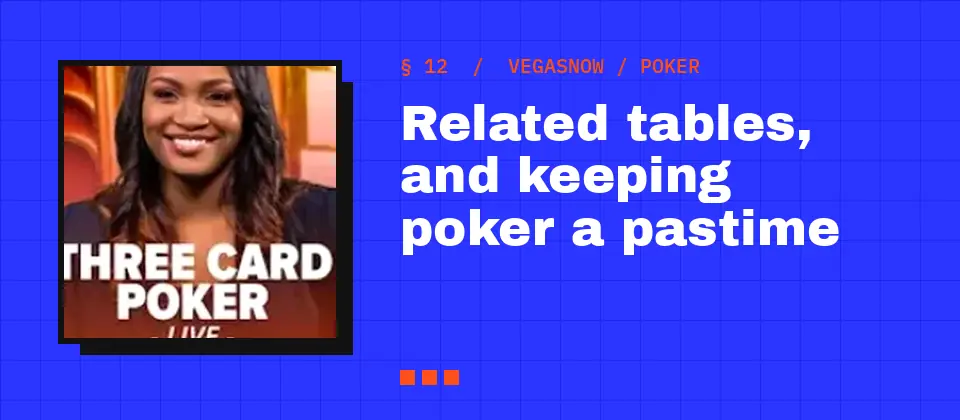
If Three Card Poker suits you, these corners of our lobby share something with it.
- Blackjack is the closest cousin: your hand against the dealer's, solved by a fixed strategy. It counts 10% towards bonus wagering.
- Roulette removes the decisions: pick a bet and the wheel does the rest. Its published bonus rate is 25%.
- Plinko is an instant game with short rounds for lighter evenings.
Our casino overview shows how the rest of the lobby is organised.
Your account tools
Any VegasNow account can carry a deposit limit, and support can arrange a cooling-off break or self-exclusion whenever you ask. A limit set on a calm day works far better than one attempted halfway through a losing run. The responsible gambling page explains each option.
Poker should never feel like a job or a debt. If it starts to, counsellors at Gambling Help Online take calls on 1800 858 858 at any hour and at no cost, and the same service is online at >gamblinghelponline.org.au.
Licence and where you play from
Just Entertainment B.V., based in Willemstad, holds the licence that covers our lobby: OGL/2024/164/0246, granted in Curaçao. Australian regulators have not licensed us, which leaves the rules of your own state or territory for you to check; our page for Australian players says more. Accounts are for adults aged 18 and over.
Reader questions
Does VegasNow have a poker room where I play against other people?
No. A player-versus-player room is not part of our published catalogue, so there is no rake, tournament or seat list here. Our poker is casino poker: each hand is compared with the dealer's under fixed rules and a printed pay table. Three Card Poker is the title our catalogue shows, and the lobby search covers any other format you have in mind.
What hand do I need to play in Three Card Poker?
Play queen-six-four or better and fold anything lower. We checked every pairing of player and dealer hands, and that cut-off loses least over time. You end up playing about two hands in three: any pair or better, any king or ace high, and queen-high hands from Q-6-4 up.
What is the house edge on Three Card Poker?
With the Q-6-4 rule and an example ante bonus (straight 1:1, trips 4:1, straight flush 5:1), our own calculation gives 3.37% of the ante, or 2.01% of everything staked once play bets count. Playing every hand pushes it to 7.65% of the ante. Ante bonus tables vary, so read the help panel on your table.
Is the Pair Plus bet worth playing?
That depends on the pay table. By our figures, paying 1, 4, 6, 30 and 40 to 1 on a pair, flush, straight, trips and straight flush gives a 2.32% edge, while trimming the flush to 3:1 lifts it to 7.28%. Check the real numbers in the help panel before you decide.
Can I use my VegasNow welcome bonus on poker tables?
Poker is not named in our published contribution list, which covers pokies, roulette, blackjack, game shows and baccarat. Check the full terms in your account or ask support before staking bonus funds at a poker table, and keep each round within the A$8 maximum bet. You can also decline the bonus and play with your deposit alone.
How is Casino Hold'em different from Texas Hold'em?
Both use two private cards and five shared ones, but Casino Hold'em is played only against the dealer. After the flop you either call with twice your ante or fold, and the dealer usually needs a pair of fours to qualify. There is no bluffing, no betting against other people and no pot; payouts come from a printed pay table.
Can I play live dealer poker on my phone?
Yes. Every table, live or software, opens straight in your phone's browser, Safari or Chrome, with nothing to install. Store apps and APK files are not part of how we work. Pin the casino to your Home Screen for quick access, and use steady Wi-Fi with the phone turned sideways at live tables.
Is it legal to play casino poker at VegasNow from Australia?
Just Entertainment B.V. runs VegasNow under licence OGL/2024/164/0246, granted in Curaçao. We hold no Australian licence, and you are responsible for the rules of your own state or territory. Every account holder must be 18 or older. Our page for Australian players sets out the position in more detail.
Where can I get help if poker stops being fun?
Start with your account: support can set up a deposit limit, a cooling-off break or self-exclusion whenever you ask. Beyond us, the free national line 1800 858 858 run by Gambling Help Online is staffed at any hour, and >gamblinghelponline.org.au offers confidential support online.
 StarburstNetEnt
 AviatorSpribe
 SpacemanPragmatic Play
 MinesVegasNow lobby
 Sweet BonanzaPragmatic Play
 AviatrixAviatrix Studios
 Big Bass BonanzaPragmatic Play
 Gates of OlympusPragmatic Play
 Gates of Olympus Super ScatterPragmatic Play
 Royal ExpressPlayson
 Gold ExpressBooongo
 Pink JokerPlayson